





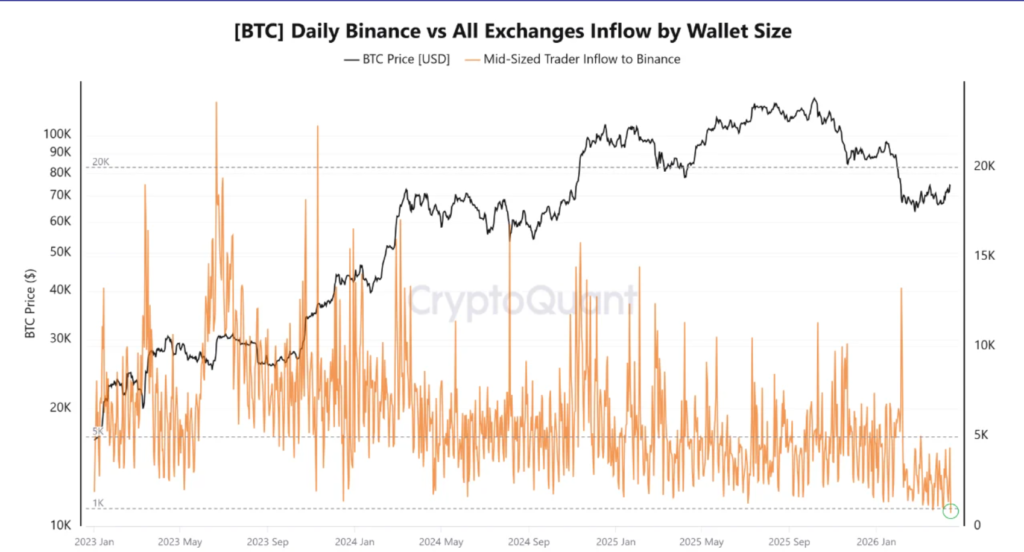
A metric that rarely draws the spotlight has just printed its most significant reading in over two years. Daily mid-size trader inflow to Binance has fallen to 725 BTC, marking the first time this cohort’s exchange deposits have dropped below the 1,000 BTC threshold since January 2023. For analysts tracking the behavioral patterns of Bitcoin’s most market-relevant holder group, the reading warrants careful attention.
Why Mid-Size Traders Are the Right Cohort to Watch
Bitcoin’s ownership landscape is typically discussed in binary terms: retail versus whales. However, that framing glosses over a structurally important middle layer. Mid-size traders that are classified on the basis of wallet size thresholds that place them above typical retail holders but below institutional-scale addresses that take up a unique position in the market. They are active enough to respond to price signals in real time, hold sufficient size to move measurable supply onto exchanges, and have historically been among the first cohorts to shift behavior ahead of broader market turning points.
Their inflows to Binance, the world’s largest spot trading venue by volume, function as a reasonably reliable proxy for the near-term sell-side intentions of this group. When mid-size wallets send BTC to Binance in volume, that supply is being positioned for potential liquidation. In the case of these inflows contracting sharply, the read-through is that this cohort is not actively distributing.
Placing the 725 BTC Reading in Context
To understand the significance of 725 BTC, it helps to trace what normal looks like. According to the CryptoQuant chart tracking daily Binance inflow by wallet size from January 2023 through April 2026, mid-size inflows have oscillated across a wide range. During peak activity periods in early 2023, inflows from this cohort reached spikes approaching and crossing over 20,000 BTC in single sessions. Even during calmer stretches in 2024 and early 2025, daily readings were routinely held in the 5,000 to 10,000 BTC range, and there were also frequent spikes above that.
The 5,000 BTC level, visible as a reference line on the chart, has functioned broadly as a baseline floor across much of the past two years. The current reading of 725 BTC sits dramatically below that floor, not just dipping toward the 1,000 BTC reference line but breaching it and settling near zero on the right-hand axis. This is not a minor fluctuation within a normal distribution; it is a reading that falls at the lowest end of the entire two-plus year dataset.
What the Data Actually Highlights
The direct implication of this reading is straightforward: mid-size traders are depositing materially less Bitcoin onto Binance than at any point since early 2023. Because exchange inflows represent coins being moved into positions where they can be sold more readily, a contraction of this magnitude points toward reduced near-term sell-side pressure from this cohort specifically.
It is worth being precise about what “reduced sell-side pressure” means in practice. It does not mean these wallets are accumulating aggressively or that buy-side demand has increased to offset selling. It means that one historically active source of exchange-bound supply has, at least temporarily, withdrawn.
Bitcoin’s price, as reflected in the same CryptoQuant chart, pulled back from highs above $100,000 reached in late 2024 and early 2025, and has since been consolidating in the $65,000 to $75,000 range through early 2026. During that prior peak period, mid-size inflows to Binance were visibly elevated, consistent with a cohort that was actively moving supply onto exchanges into strength. The fact that inflows have now collapsed to 725 BTC during a consolidation phase, rather than a new price high, reframes what this signal actually represents. This cohort is not holding back because prices are surging and they feel no urgency to sell. They are holding back at levels that are roughly 30% to 35% below the cycle peak, which suggests something closer to a deliberate reassessment of distribution strategy than a passive response to market conditions.
The Technical Side for the Market Participants
For traders monitoring short-to-medium-term price dynamics, the signal here is one of supply compression from a specific but meaningful cohort. When a specific group of the market’s typical sell-side contributors reduces its exchange-facing activity to a two-year low, the structural supply-demand balance slightly favors buyers, assuming all other factors remain constant.
For longer-horizon investors, this data point deserves to be read carefully rather than conclusively. A single cohort pulling back from exchange deposits does not, on its own, create upward price pressure, nor does it neutralize the macro variables and broader risk-off sentiment that continue to weigh on Bitcoin’s price structure. What it does establish is a behavioral distinction worth noting: mid-size wallets are not positioning to distribute current prices the way they were when Bitcoin was trading above $100,000 in late 2024 and early 2025. That shift in posture, from active distribution near cycle highs to near-complete inflow withdrawal during consolidation, represents a material change in how this cohort is engaging with the market. Whether that change reflects conviction about future price levels, simple profit-taking exhaustion, or something in between is not something the data resolves. What the data does confirm is that the behavior has changed, and the degree of that change, from routine inflows in the 5,000 to 10,000 BTC range down to 725 BTC, is too significant to treat as noise.
The reading also raises a forward-looking question: what would cause inflows to re-accelerate? Historically, sharp inflow spikes from mid-size wallets have coincided with both price peaks and periods of significant market stress, as holders rushed to exchange liquidity in either case. A sustained period of low inflows, by contrast, has sometimes preceded price stabilization or gradual appreciation as available sell-side supply thinned out.
Conclusion
the priceA single day’s inflow reading, does not define a trend, and one metric does not make a trade. But the 725 BTC mid-size inflow figure is notable precisely because it is not ambiguous. It is the lowest reading in over two years, the first breach of 1,000 BTC since January 2023, and it arrives during a period when the price has been consolidating well below cycle highs. The data points to a cohort that is, for now, stepping back from active exchange distribution. Whether that behavioral shift persists or reverses will be a metric worth tracking closely in the sessions ahead.


