



Solana price faces renewed pressure after another failed push into resistance, and the charts now point to a fragile setup across multiple time frames. On the 4-hour chart, sellers still control the $86 to $88 zone, while the monthly structure shows Solana (SOL) trapped below a much larger ceiling near $108.
Solana Price Stalls Again Below Near-term Resistance
Solana price has struggled to build momentum after its latest rebound attempt. The recent move lost strength before reaching a clean breakout, and that failure keeps the short-term trend under pressure.
On the 4-hour futures chart, SOL remains inside a broad trading range. That structure formed after a sharp decline earlier in the year. Since then, each recovery has run into selling pressure before bulls could regain control.
The most recent rejection came just below the upper supply area between $86 and $88. That zone has become the key line on the chart. As long as Solana price stays under it, the market keeps a bearish tone.
KNIGHT’s setup points to that same concern. The chart outlines a possible path lower, starting with a break through nearby support and extending toward the lower end of the range. In practical terms, that means SOL could slide toward the $67 area if sellers press the market lower.
This repeated rejection matters for one reason. Failed rallies often weaken support over time. Each stalled bounce gives sellers another chance to test the lower boundary.
Besides, Solana price now trades from the middle-to-upper part of the range instead of near the bottom. That leaves more room below than above if momentum turns lower again. Consequently, traders may treat any weak rally as another selling opportunity until the structure changes.
A decisive move above $88 would challenge that outlook. However, the chart does not show that shift yet. Until buyers reclaim that zone, the downside scenario remains active.
SOL Price Signals Weak Recovery Attempt
Over the last 24 hours, Solana price has shown only mild weakness on the daily chart. The latest candle posted a modest 0.86% decline and closed near $83.24. During the session, SOL price moved in a tight band between about $82.75 and $84.03.
That kind of range does not suggest panic selling. Instead, it signals hesitation and low conviction. Even so, the larger trend still looks weak because SOL trades every major moving average on the chart.
The 20-day EMA sits near $83.98. The 50-day EMA stands near $87.34. Above those, the 100-day EMA rests around $98.44, while the 200-day EMA stays much higher near $118.88.
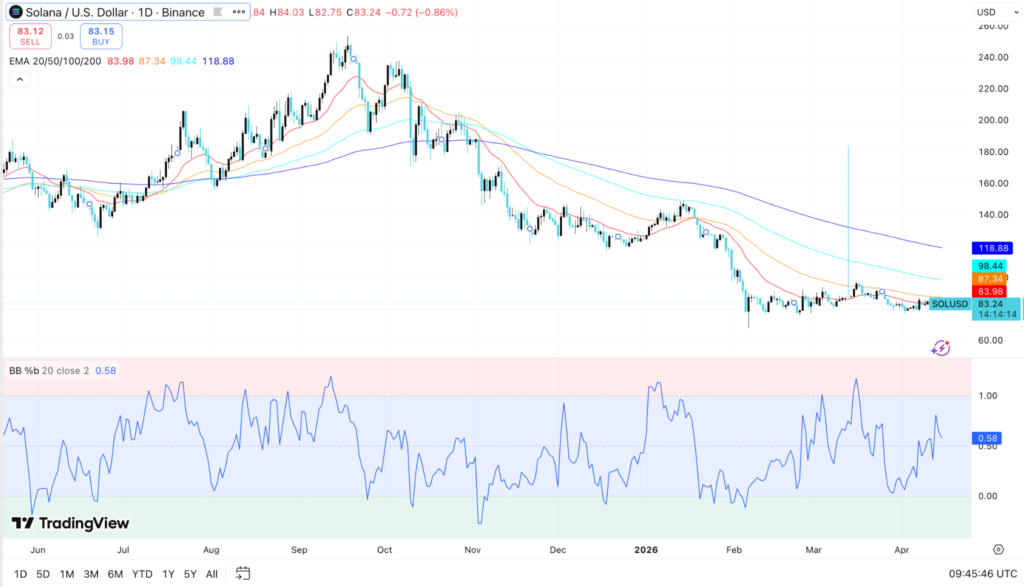
SOL/USD 24-Hour Price Chart: Source: TradingView
That alignment paints a clear picture. Shorter-term averages remain below longer-term averages, and price sits under all of them. Hence, the market still trends lower unless Solana price can reclaim key levels.
The first test now sits between $84 and $87. That area includes the 20-day EMA and leads directly into the same resistance region seen on lower time frames. A close above that band would improve short-term momentum and could open room toward the 100-day EMA.
On the downside, the intraday low near $82.75 serves as immediate support. Below that, the market will likely focus on the broader base near $80. If that floor gives way, sellers could drag Solana price back toward the high-$70s.
Moreover, the Bollinger Band %b value of 0.58 positions SOL in the middle to the upper part of its recent range. That implies a neutral momentum with a minor rebound. Nevertheless, it does not affirm a breakout or a more widespread change of trend.
Solana Open Interest Drops as Shorts Rise
Technical weakness has also appeared in derivatives positioning. CoinGlass data shows Solana futures open interest fell 5% over the last 24 hours to $4.91 billion. That drop suggests traders have reduced exposure instead of adding conviction behind a strong directional move.
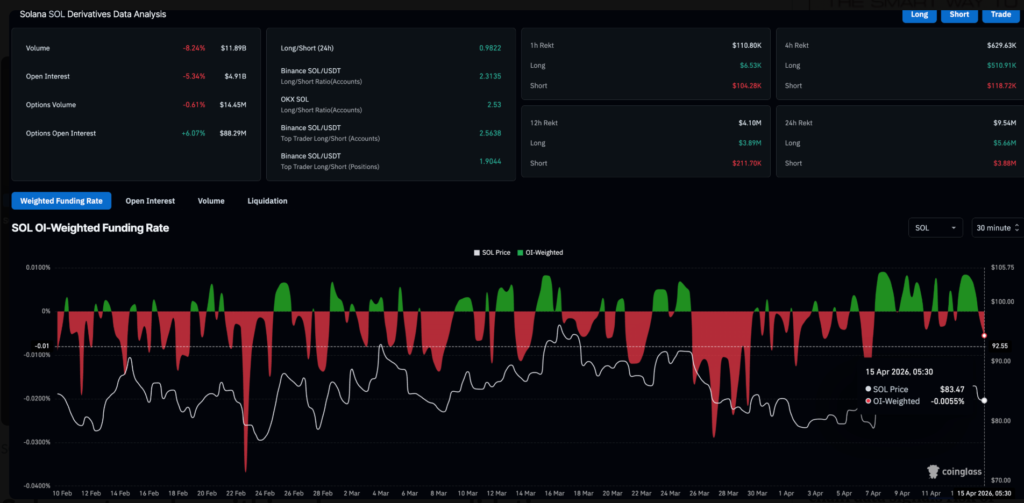
Source: CoinGlass
Meanwhile, the funding rate decreased to -0.0055%. This number indicates that traders have shifted a bit towards short positions. The long-to-short ratio of about 0.9822 substantiates that sentiment and indicates a wary market sentiment.
These are not indications of a steep decline. Nevertheless, they assist in understanding why Solana price has difficulty breaking resistance. When the open interest is low and the funding rate is negative, the market can hardly support a robust recovery.
In addition, there is an additional pressure of decreased retail demand. Traders tend to withdraw initially in unpredictable situations in altcoins that require greater strength to regain their footing. Solana now seems to follow that pattern.
Solana ETF Inflows Offer Limited Support
Though futures data are pointing at the weak, fund flow data is a more balanced indicator. SOL spot ETFs also registered inflows of 1.27 million, according to SoSoValue. That number can be considered small, but it is significant since it breaks a series of three consecutive outflows in the form of weekly.
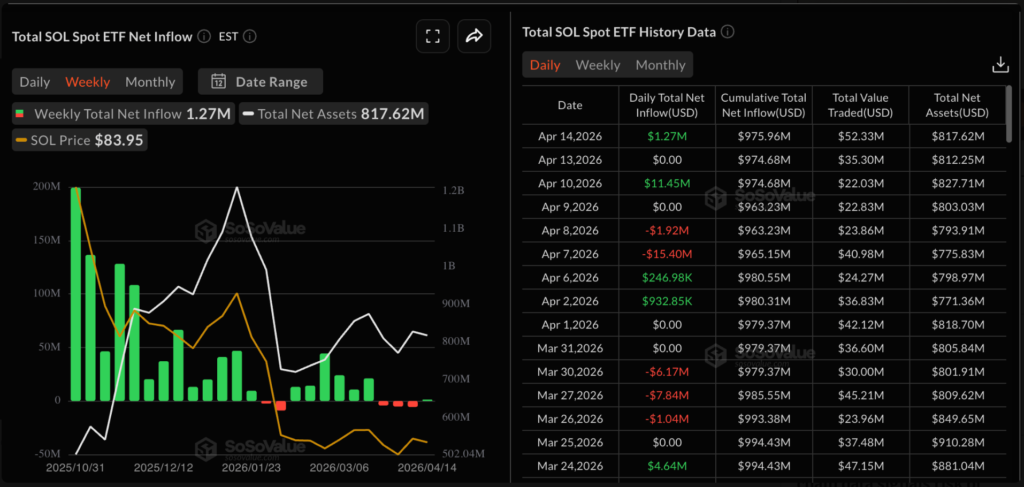
Source: Sosovalue
That turn might herald a revival of interest by bigger market players. Nevertheless, it is not large enough to turn around the bigger picture on the chart. At this point, ETF inflows are more of a stabilizing agent rather than a bullish driver.
Notably, Solana price has failed to react with a breakout despite such assistance. That detachment indicates that the market has not yet reached the point where it can gain significant demand, and momentum can then work sustainably.
Solana Price Risks Slide Toward $49
The short-term setup looks fragile, but the monthly chart raises an even bigger question. Analyst Ali has pointed to a long-term ascending channel that still frames Solana’s broader structure. Within that channel, $108 stands out as major resistance, while $48.95 marks critical support.
That wider view changes the discussion. Instead of focusing only on the next few dollars, it asks whether Solana price can hold the broader trend at all. Recent monthly candles show that SOL failed to stay above the $107.77 region, which aligns closely with Ali’s resistance level.
Since that rejection, the price has drifted lower and moved back into the middle of the structure. That leaves Solana without a confirmed breakout on the macro chart. Instead, it remains stuck between a ceiling near $108 and support near $49.
If the current weakness continues, the $48.95 level becomes much more important. That zone has acted as a key structural area before, and buyers may need to defend it to preserve the long-term channel.
Consequently, the monthly chart suggests that downside risk extends far beyond the current trading range. A move toward $49 would not happen overnight, yet the chart shows that possibility if weakness continues across the coming months.
Final Take
The market has two clear checkpoints. The first sits overhead at $86 to $88. Solana price must clear that area to weaken the immediate bearish case. Without that move, every rally remains vulnerable to another rejection.
The second checkpoint sits lower near $80 and then around $67. If those supports fail, the market could begin pricing a deeper decline.