
Another particularly bullish altcoin rally highlight is Peanut the Squirrel (PNUT), currently up 61.17% over the past 7 days, reaching up to $0.0880 this session before dropping and closing the day candle around $0.0684. This chart appears to show a momentum bounce reaching the first major resistance, indicating whether we are in an ongoing bullish trend or experiencing a relief from an oversold position that has expired.
What the Chart Actually Shows
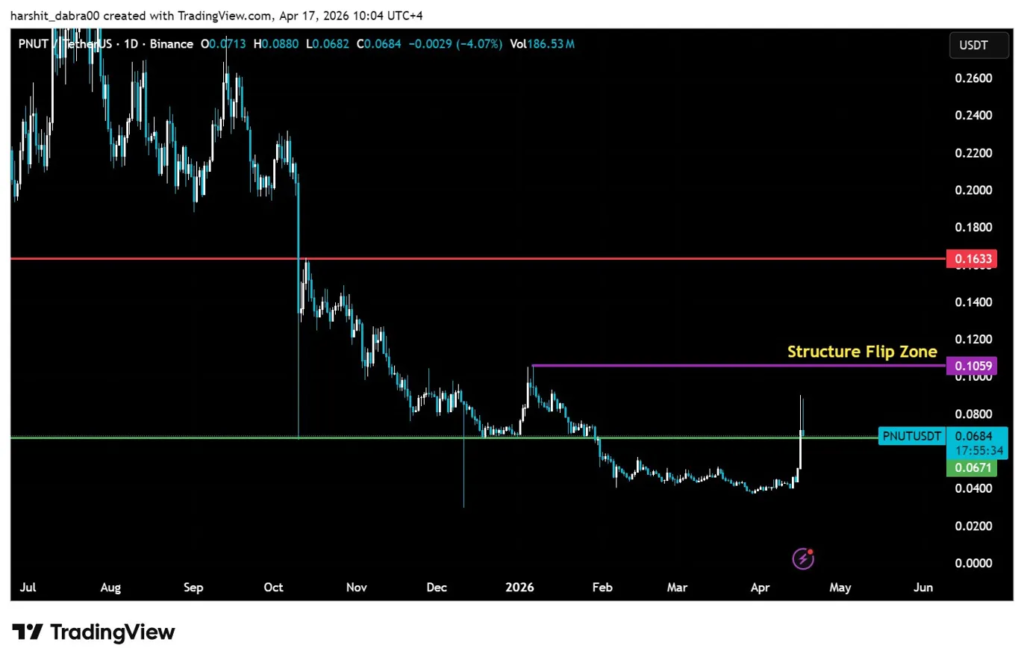
On the daily chart it can be noticed that the price for PNUT traded from approximately mid-September 2025 up until April 2026 within an 8-month descending channel, reaching the top of that range approximately between $0.2400 and $0.2600, continually creating lower highs and lower lows until it was trading in the $0.0400-$0.0450 range by mid-late March and early April 2026; this also happened to be the bottom of the structure.
The spike that we can see in the chart on the right is essentially an almost vertical impulse that moved from around $0.0450 during March lows to the highs of the day at $0.0880 while writing. Two things are interesting to note about that candle. First of all, the candle closed well below its highs, making that a nice long upper wick that was representative of strong selling intraday. Second (and more importantly), this high was repelled at a level of resistance that has been easily defined on the chart and clearly seen as a resistance area (in green), with that horizontal level marked at $0.0750–$0.0800 and on the chart at $0.0671. Yesterday’s close (at $0.0713) was a pullback into that battleground, not a solid breakout.
An even greater structural level overhead, shown on the chart in the purple horizontal box section within the “Structure Flip Zone” at $0.1059, where previously support existed in Dec ’25 & Jan ’26, where PNUT traded horizontally for many weeks before falling below this area. In market structure terms, levels where support fails tend to form resistance, which is what this area of $0.1059 represents. If the level is successfully regained, the next major area of reference would be the red resistance line at $0.1633, which has held as a level since the break below here in Oct ’25.
What the Indicators Are Communicating
This shows us how strong the rally is, but the stack is now around numbers that have before been ahead of an immediate range or sharp mean reversion. The 7 (87.25) and 14 (79.58) and 21 (73.09) periods are all now above the normal 70 figure of overbought, but RSI numbers can remain high for long periods in a true trend; they just indicate that most of the immediate momentum is now through the price action, and more buying will need to either come from a structural change or consolidation of the oscillators
The MACD is also well positioned, as the MACD line (0.0027122) has crossed above the signal line (0.00017802), making for a 0.0025342 histogram. High RSI and high MACD divergences like what is shown above are typical in the very beginning stages of a bull trend, indicating the trade has already played itself out and is looking to further run, although risk reward on the present level has drastically decreased.
Lastly, the moving averages give some perspective as the 7-period SMA ($0.04813) and 30-period SMA ($0.04299) are significantly below the price, indicating how vertical the recent move has been, but the 200-day SMA ($0.08378) is still above the price ($0.06959), so no move has yet occurred up to the trend average, and until that occurs on the daily chart, a recovery cannot be declared.
The Fibonacci Structure and what this means for the levels
According to the drawn Fibonacci levels and using the $0.03710 swing low and $0.08849 swing high, the Fibonacci retracements have fit themselves nicely within the price action. At the 38.2%, we are finding retracement at $0.06886 only minutes after the actual close at $0.0684, and it is serving as the first line of immediate support for our current downward intraday push from the swing high. At 50% is the next Fibonacci retracement at $0.06280 and, should $0.06886 not hold as support, it will likely serve as the next level of significant support.
It is important to note the extensions at the 127.2% Fibonacci extension, which are now sitting at $0.10247 and are just below the structure flip zone that we found at $0.1059. Both the Fibonacci extension level and the previous level of structural support turned resistance are at $0.1059, creating only one area of price to watch moving forward. We will want to see a push-up from PNUT that tests the $0.1025-$0.1059 area, as a close at $0.1059 and above with volume would signify a true turn in price, while a failure would prove our current movement to be nothing more than a corrective bounce.
The Volume and Intraday Behavior
A volume of $313.46 million for a market cap of $69.58 million represents a 24 hr volume to market cap ratio well over 4:1. This is phenomenal and is a speculative pump, not a “normal” build-up. Look at the intra-day price history via the UTC timestamps; PNUT went from $0.05427 at 06:00 UTC on 4/16 to $0.07775 at 19:15 UTC. That’s an intra-day pump-up of 43.2% in 13 hours before selling off at 00:00 to $0.07100. Then it pumped again to $0.07656 at 03:10 UTC on 4/17 before dropping back to $0.06968 at 05:55 UTC. The quick intra-day 2 peak structure and successive lower high indicate that traders are taking profits into the strength, rather than engaging in natural direction buying.
The daily pivot at $0.070116 is the near-term pivot; holding the $0.070116 area on a closing basis leaves the short-term structure intact. If the price remains below $0.0628 (the 50% Fibonacci retracement level), it will raise doubts about the sustainability of the rally. The only actual confirmation of a shift in structure occurs when the Structure Flip Zone is reclaimed at $0.1059 and held, which is 52% above the current price; thus, the longer-term downtrend that formed from August to September 2025 remains in effect.