





Solana price slipped again on April 20 as traders reacted to two pressures at once. Broader market fear followed Iran’s closure of the Strait of Hormuz on April 19. At the same time, the KelpDAO exploit deepened stress across decentralized finance. Together, those forces pushed SOL lower and kept the market focused on downside risk near $80. However, in the last 24 hours, SOL price is trading in an upward direction with an increase of 0.75%, exchanging hands at $85.22.
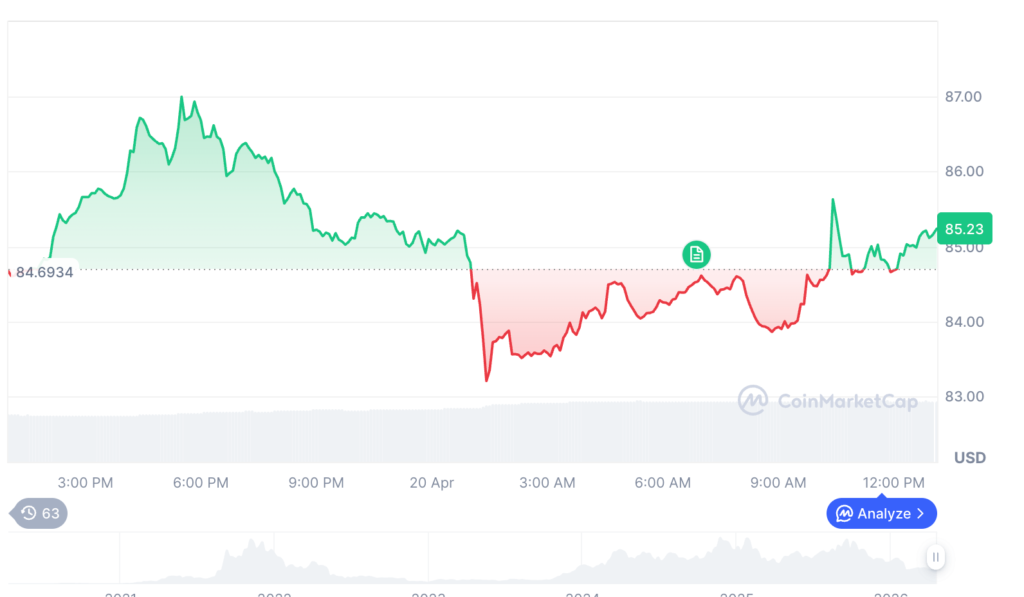
SOL/USD 24-hour price chart: source: CoinMarketCap
Macro Stress and DeFi Fallout Hit SOL Together
Risk appetite for digital assets decreased as geopolitical tensions in the Middle East escalated. Bitcoin also fell, and the overall crypto market cap pulled back. That general frailty formed a challenging context of high-beta tokens like SOL. Beyond this, the pressure came at a time when DeFi markets had taken in a significant exploit.
The KelpDAO attack added a second layer of concern for Solana price. The exploit drained 116,500 rsETH through a LayerZero-linked route. After that, the attacker used the stolen assets as collateral on Aave V3. That move allowed large WETH borrowing and left Aave facing heavy bad debt. Consequently, liquidity conditions tightened quickly across several protocols.
The shock was not restricted to Ethereum-based platforms. The ETH pool of Aave was at full capacity, and big holders scrambled to withdraw liquidity. Traders monitored lending markets on Solana to detect the same. The usage of the USDC increased to 100% in the key pools at Kamino Finance. Moreover, some of the vaults shifted over 95, and this brought up the issue of stress in wrapped-asset exposure.
That cross-chain tension matters because Solana often reacts quickly to liquidity shifts. Traders do not need direct protocol exposure to reduce risk. They often sell liquid tokens first, and SOL remains one of the easiest targets. Hence, the exploit likely amplified downside pressure even as the network itself stayed active.
Solana Price Holds Support, but Resistance Remains Close
Recent price action shows a market trying to stabilize without proving real strength. Solana price hovered around the mid-$84 area after moving between roughly $83.36 and $85.79. Buyers stepped in near the $83 to $84 zone, which now acts as immediate support. However, bulls still face a crowded resistance stack overhead.
The first barrier is the 20-day EMA around the $84.91 mark. Most importantly, the 30-day SMA around $85.29 acts as an upper boundary as well. Another technical barrier is the 23.6% Fibonacci retracement of 86.15. As a result, it will take Solana price a number of clean breaks before sentiments can turn around.
A push through $86.15 would not confirm a trend change by itself. Still, it would show that buyers can reclaim nearby resistance. After that, the 50-day EMA near $87.16 becomes the next important test. Moreover, a daily close above that level would likely reduce immediate downside pressure.
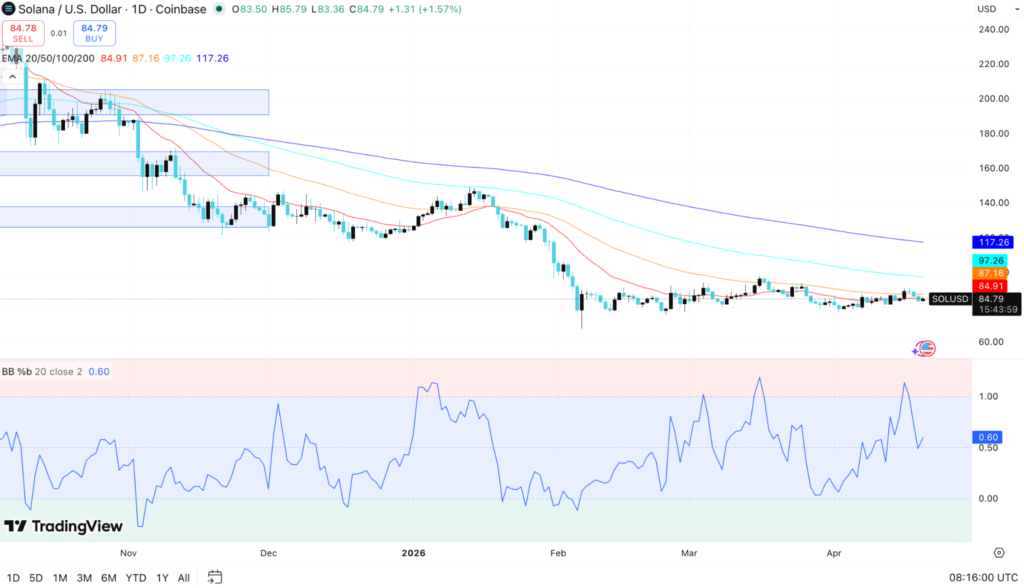
SOL/USD 24-hour price chart : source: TradingView
Solana price is lower compared to the 20-day, 50-day, 100-day, and 200-day exponential moving averages. Those averages sit around $84.91, $87.16, $97.26, and $117.26. The medium-term momentum thus remains in favour of sellers despite recent attempts to recover.
Bollinger Band data suggests moderate improvement, but not a breakout. The %b reading near 0.60 places SOL in the upper half of its recent range. That shows some buying interest returning. However, it does not show strong conviction yet.
Open Interest Raises the Risk of a Fast Move Toward $80
The biggest short-term concern may come from derivatives rather than spot trading. Futures open interest has climbed by about 20% in recent sessions. Rising open interest often signals stronger participation, but it can also increase fragility.
A break above resistance could squeeze shorts and send SOL higher. However, a drop below support could trigger forced selling and deepen losses. Significantly, the downside path looks more exposed because the price still sits under major moving averages.
Analysts tracking order books have identified two important liquidity zones. One cluster sits above $90, while another rests below $85. That structure suggests the market may first test the lower pocket before attempting a broader recovery. Hence, traders continue to watch the $83 area very closely.
If Solana price loses that support, the market could slide toward $80 quickly. That level carries both psychological and technical importance. It also sits near the area where liquidation pressure could intensify. Consequently, even a modest decline could snowball into a sharper drop.
SOL Faces Pressure Below Major Ceiling
While short-term risk dominates, the upside map remains clear. A recent 4-hour chart highlighted repeated rejection near the low-$93 region. That ceiling matters because SOL has already spent meaningful time trading in the upper $80s and low $90s. Volume profile data confirms heavy activity in that band.
When a price revises a high-volume area, the reaction is usually more weighted. An escape from that area can bring new impetus. Conversely, the rejection of another can entrap and strengthen selling among the late buyers. Hence, the major upside checkpoint is the low-93 area.
Any move above that ceiling would break into a run in the mid-to-upper 90s. This kind of rally would probably need to have better market sentiment and less turbulent DeFi. Moreover, SOL would have to maintain pulled-back support levels during any pullback. A breakout might not last long without that follow-through.
The alternative remains simpler and more immediate. If the Solana price cannot build above the nearby resistance, sellers may regain control. In that case, the market may revisit the mid-$80s first and then challenge $80. That downside path fits the current caution seen across crypto.
Solana Fundamentals Support Price Amid Pressure
Though the recent weakness is present, the underlying Solana has provided strengths in certain areas. As of the first quarter of 2026, the network had transacted 1.1 trillion. It also carried out 25.3 billion transactions and 3.78 million daily active addresses. Those figures indicate that there is continued high usage despite price turbulence.
ETF flows also provide support for the broader Solana story. Spot SOL ETF cumulative net inflows moved above $1 billion. Additionally, the week ending April 17 brought in $35.17 million, which marked the strongest weekly intake since February. That demand does not erase current risks, but it does show durable market interest.
Still, strong fundamentals do not always protect price in the short term. Markets often react first to liquidity shocks, macro fear, and leveraged positioning. Solana price now sits at the intersection of all three. Hence, traders may keep favouring caution until the chart improves.
Final Take
For now, the market has a clear framework. Support sits around $83 to $84, while resistance begins near $84.91 and strengthens toward $86.15 and $87.16. Above that, the low-$93 zone remains the larger breakout barrier. Below that, a loss of $83 could expose the Solana price to a swift move toward $80.


