



A study of more than 150 of the largest crypto protocols by Novora found that the industry has built a deep pool of public, trackable data around revenue, usage, and token activity, yet has done far less to present that information in a structured, investor-facing format familiar to institutions in traditional markets.
The study, which examined investor relations and token transparency practices across a broad cross-section of digital asset projects, found that the problem is not whether information exists, but whether protocols choose to organize it into clear disclosures that outside investors can use to understand business performance, token economics, and capital allocation.
Plenty of Data, Little Investor-Facing Structure
Novora’s study found that 91% of protocols generate trackable revenue, but only 8% publish a token holder report, while just 18% provide quarterly updates and only 3% maintain a dedicated investor relations hub, leaving a wide gap between what can be observed on-chain and what is actually communicated in a structured way to the market.
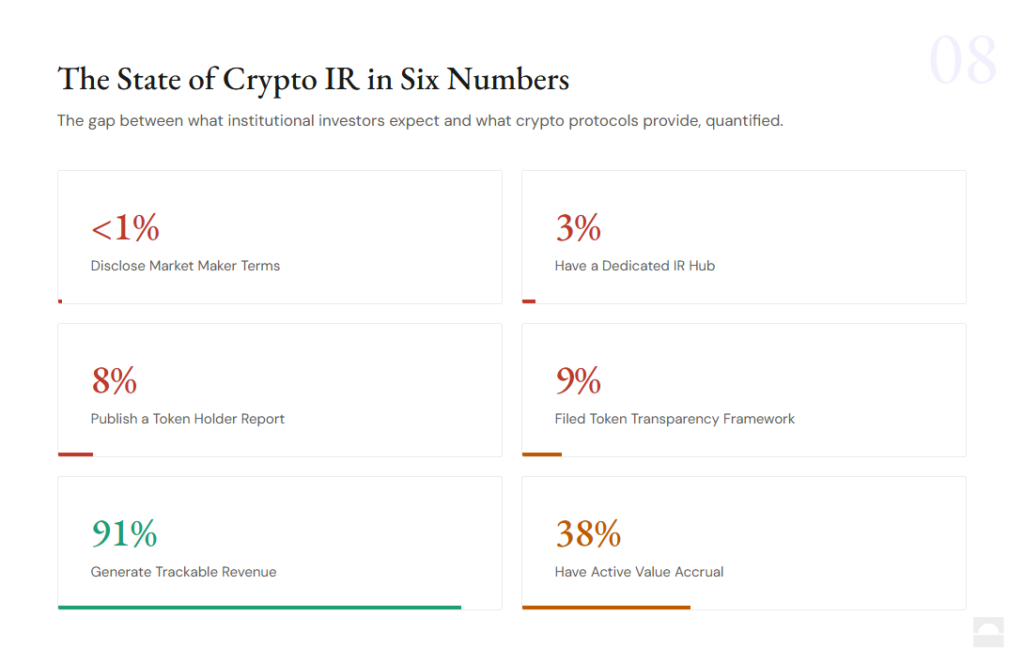
That imbalance, according to the study, reflects a deeper weakness in crypto’s approach to investor communication, where raw data may be public and increasingly easy to verify through analytics platforms, but is rarely assembled into a consistent reporting framework that resembles the standards used in equity markets.
Market-Making Remains One of the Darkest Corners
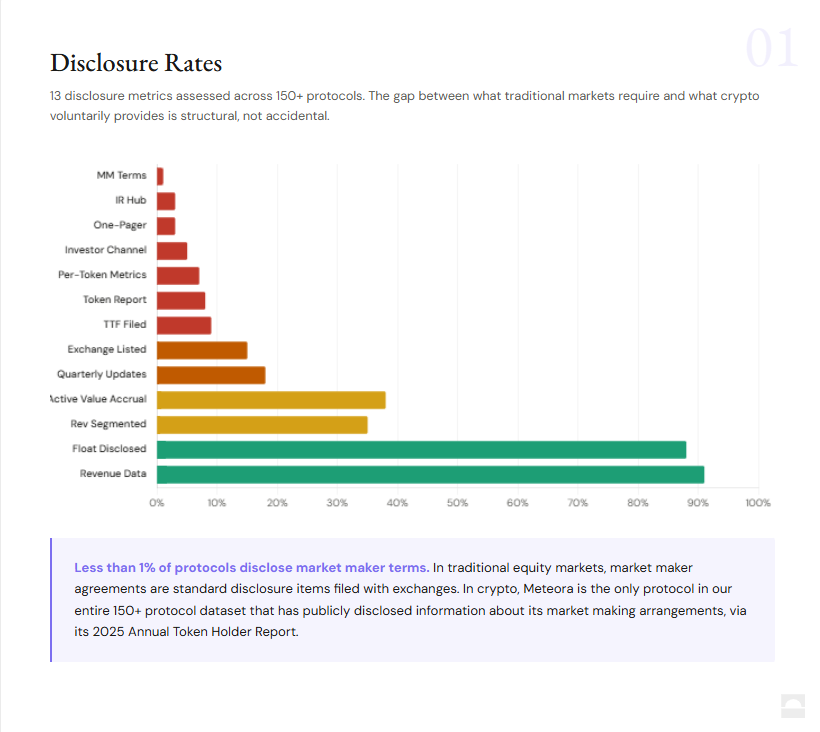
Among the weakest areas identified in the study was disclosure around market-making arrangements, with fewer than 1% of protocols providing public detail on agreements with liquidity providers, even though such information would be considered routine in traditional financial markets where exchange filings and investor materials commonly address these relationships.
Across the full dataset, Meteora was the only protocol identified by Novora as having publicly disclosed information about its market-making structure, doing so through its 2025 annual token holder report.
That lack of disclosure reflects a broader market pattern in which issuers still avoid explaining how token liquidity is arranged, supported, and managed
Third-Party Platforms Carry Most of the Burden
The study also found that gaps in direct disclosure are being partly filled by strong coverage from third-party data platforms, with 95% of protocols covered by Dune Analytics, 93% by Token Terminal, 88% by DeFiLlama, 85% by Artemis, and 42% by Blockworks.
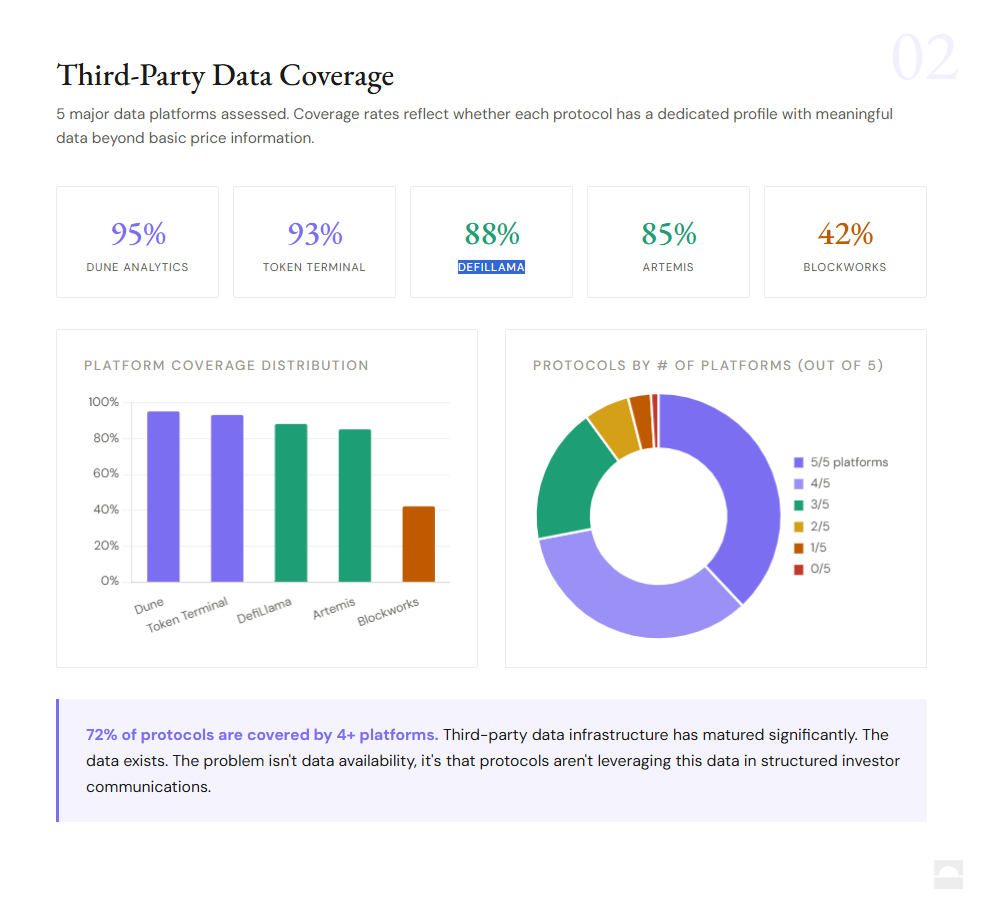
Overall, 72% of the protocols in the study were covered by at least four of the five platforms assessed, showing that outside data infrastructure is more developed than the direct communication many protocols provide themselves.
Clear Differences Across Sectors
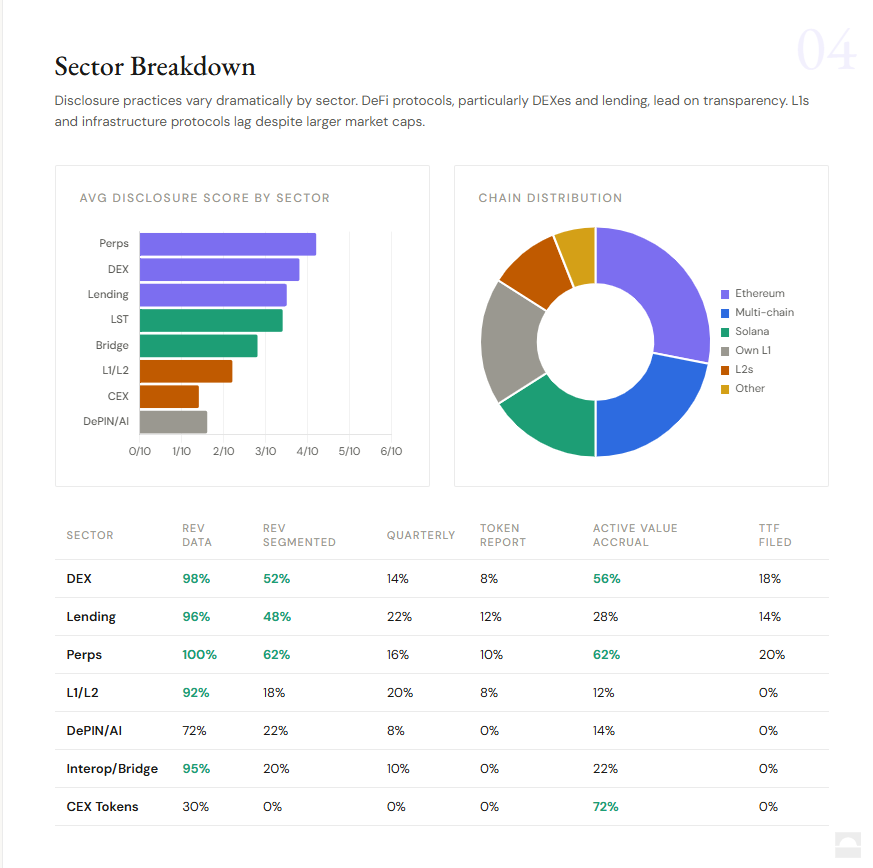
Novora found that disclosure standards vary sharply across sectors, with DeFi protocols, and particularly DEXs, lending platforms, and perpetuals, scoring better on several transparency measures than layer-1 and infrastructure projects, despite the larger size and visibility of many base layer networks.
Perpetual trading protocols stood out in particular, with 62% showing some form of active value accrual for token holders, while the figure for L1 and L2 projects was far lower, indicating that parts of DeFi have moved more quickly to connect token ownership with economic participation.
Framework Adoption Remains Limited
The Token Transparency Framework, launched by Blockworks in 2025 and presented to the U.S. Securities and Exchange Commission alongside Jito, has so far been adopted by 13 protocols, or about 9% of the sample covered in the study.
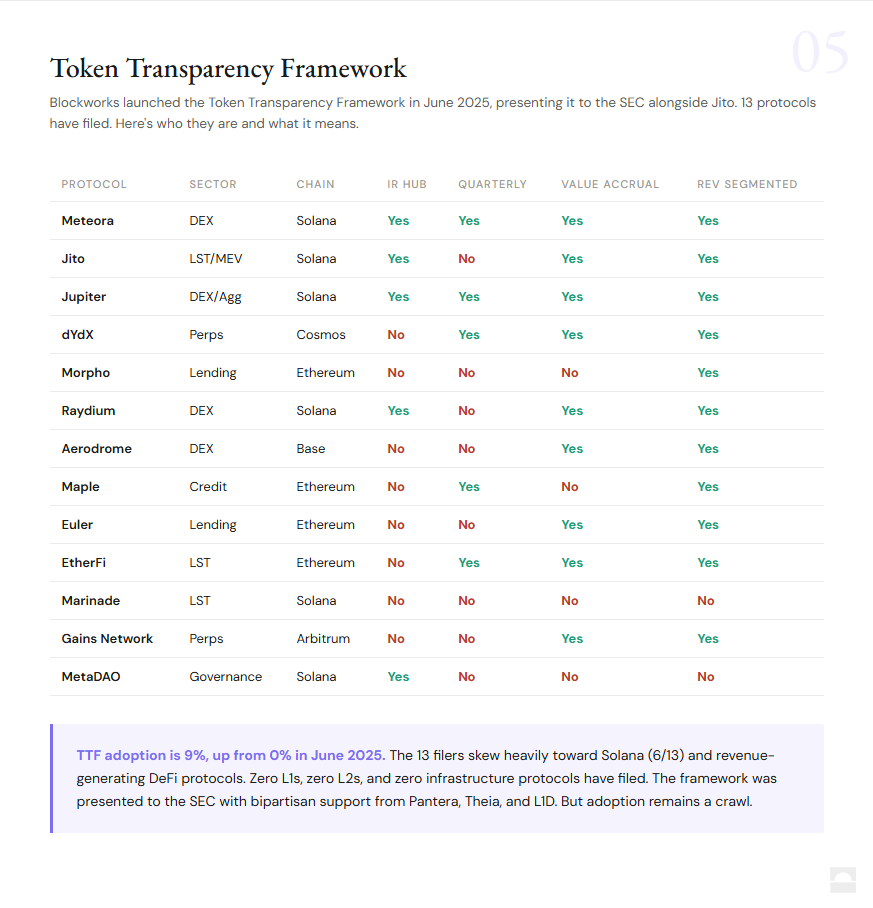
Those filings are concentrated largely among Solana-based projects such as Jupiter, Jito, and Meteora, while no major L1 or L2 network has yet adopted the framework, underscoring how slowly formal disclosure practices are spreading beyond a relatively small circle of revenue-producing DeFi names.
Revenue Remains the Bigger Driver
The study found that 38% of protocols have some form of active value accrual, whether through direct fee distribution, buyback-and-burn programs, or staking-based revenue sharing, marking a clear distinction from governance-only tokens that offer holders influence but no direct economic claim.
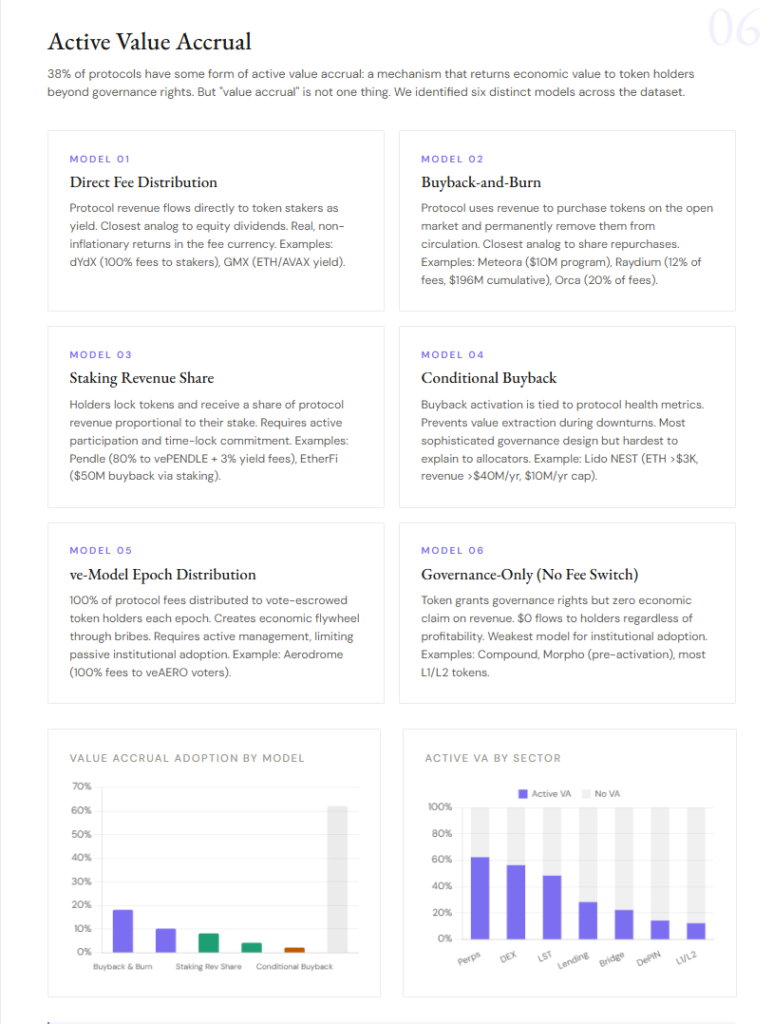
Novora said tokens with active value accrual mechanisms performed better over a one-year period than governance-only tokens, although the study also made clear that the bigger dividing line is not the specific structure chosen by a protocol, but whether the underlying business generates meaningful revenue in the first place.
Taken together, the findings portray a crypto market that has become highly legible at the data layer but remains underdeveloped at the disclosure layer, with many protocols still failing to provide the kind of regular, structured communication that institutional investors require before committing capital at scale.