





Bitcoin has gained 9.6% in the first half of April, but the more telling detail is not the number itself but instead what Bitcoin chose as a partner during this upswing. As Vytautas Mackonis, COO at ALCUM, observed, Bitcoin’s April performance has tracked copper’s 8.6% rise far more closely than gold’s comparatively modest 3.4% gain over the same period. That alignment is not a coincidence, and for anyone trying to understand where Bitcoin sits in the broader macro picture right now, it deserves careful examination.
The Asset Correlation Breakdown
The four-asset comparison Mackonis laid out tells a structured story. Gold, the conventional safe haven, posted the weakest performance of the group at 3.4%. Silver, which occupies a hybrid role between monetary store-of-value and industrial input, landed in the middle at 6.5%. Copper, the purest proxy for global industrial demand and economic expansion expectations, rose 8.6%. Bitcoin, at 9.6%, outperformed all three.
If Bitcoin was behaving primarily as digital gold, a fear-driven, capital-preservation asset, it would be clustering with gold’s performance, not copper’s. The closer tracking of Bitcoin to an industrial metal that moves on growth expectations signals something specific: market participants are currently treating it as a risk-on, cyclical asset rather than a defensive one.
What Is Driving the Risk Sentiment Shift
Mackonis points to two concrete factors underpinning this improving risk appetite. The first is diplomatic: U.S.–Iran ceasefire diplomacy, initiated on April 8, introduced a degree of geopolitical de-escalation that reduced a meaningful tail risk that had been weighing on markets. The second is economic: China’s manufacturing PMI printing at 50.4 a reading that places it in expansion territory, offered tangible evidence of stabilization in global growth expectations rather than mere speculation about it.
Together, these two data points created a backdrop where cyclical assets could breathe. Copper responded to the manufacturing signal. Bitcoin, apparently, responded to the same underlying logic. This is not a narrative construct; it is visible in the relative performance numbers across all four assets during this specific window.
Silver’s 6.5% gain further reinforces the interpretation. Silver historically struggles to outperform gold in pure safe-haven environments because its industrial demand component drags on sentiment when growth fears dominate. In April, silver’s intermediate performance, above gold and below copper, suggests that the market is pricing in improving industrial momentum while retaining some residual demand for safety. Bitcoin’s position above copper in that hierarchy suggests its risk-on repricing has been the most aggressive of the group.
The Technical Picture Converges
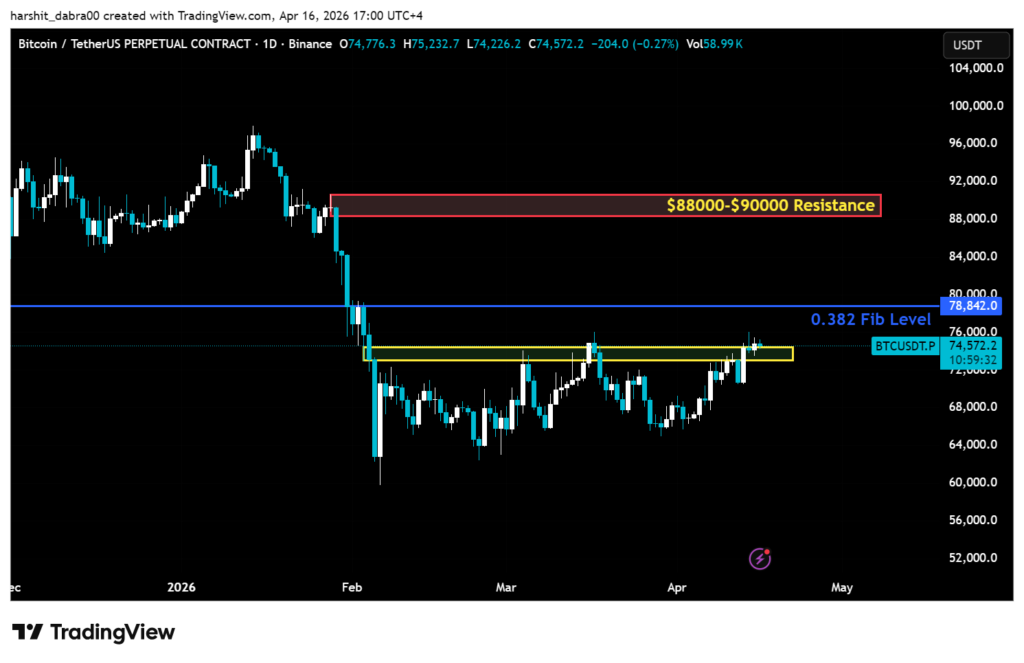
This macro backdrop converges with a technically significant level that Bitcoin is now approaching. A heavy liquidity cluster is concentrated between $75,000 and $76,000, a zone that has been building since early March and contains a layered mix of trapped participants: late short sellers who entered expecting continued downside and early breakout buyers who were caught on the wrong side of subsequent price action.
In the case that Bitcoin clears this zone cleanly, it follows a specific logic. Short sellers would be forced to close positions by buying back into a rising market, while sidelined buyers re-entering simultaneously would amplify upward pressure. That combination could compress the price sharply through the resistance rather than grinding above it incrementally. The next liquidity pocket above sits between $77,500 and $79,300, which would represent the following level of meaningful resistance if the $76,000 zone successfully flips to support.
The critical condition is not just a break of $76,000, but a sustained hold above it. A close above the level that then depends on a retest would confirm that buyers have structurally absorbed that supply zone. A false breakout followed by a return below $76,000 would invalidate the setup entirely, potentially reintroducing selling pressure from the same participants who were squeezed temporarily higher.
What This Means for How Bitcoin Is Being Priced
The convergence of macro correlation data and technical structure offers a more complete picture than either analysis would on its own. Bitcoin rallying from above $74,000 toward the $76,000 resistance zone in an environment where it is tracking copper rather than gold means that the buyers behind this move are not defensive allocators seeking shelter. They are participants expressing a view on risk and economic expansion, which is a different, and arguably more fragile, type of demand.
That distinction matters because cyclical rallies are sensitive to the same inputs that created them. If China’s PMI deteriorates, if the ceasefire diplomacy stalls, or if U.S. economic data surprises to the downside, the correlation that lifted Bitcoin alongside copper works in both directions. The macro tailwinds that Mackonis identified are real, but they are also reversible.
Forward Outlook
If Bitcoin clears and holds $76,000, the path toward the $77,500 to $79,300 zone opens, with the technical squeeze dynamic potentially accelerating that move. The macro context, specifically the risk-on rotation visible in Bitcoin’s correlation with copper rather than gold, provides a fundamental basis for why that breakout could have follow-through rather than immediately fading.
However, should Bitcoin fail to hold above $76,000, the same liquidity cluster becomes a ceiling, and a market that has been repricing toward cyclical risk rather than safe-haven demand would have limited structural support below.


