





Polygon Labs has announced the launch of its native liquid staking token, sPOL, aiming to mobilize more than 3.6 billion staked POL (worth approximately USD 330 million) into the network’s Decentralized Finance (DeFi) ecosystem. Currently, only around 4-5% of POL is used as liquid funds, compared to Ethereum, where 43% of staked coins are liquid, representing a massive penetration, primarily due to the fragmented market and third-party Liquid Staking Tokens (LSTs) that typically charge fees of 5% to 16% when users want access to their staked funds.
How does the new sPOL token work?
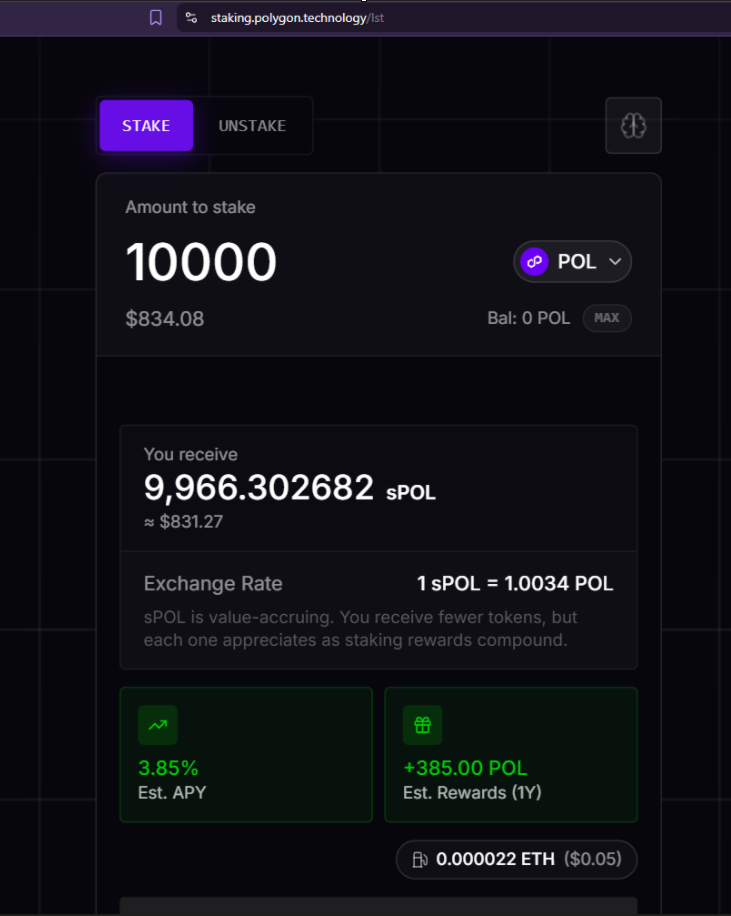
When staking POL via the new standard, users receive the same amount (1:1) of sPOL. In addition, the value of sPOL will grow over time with the accumulation of rewards from staking, and these tokens are also freely transferable for use as collateral, liquidity provision, or within DeFi yield strategies. Existing stakers may also convert staked POL into sPOL via the Polygon staking portal with no waiting period or interruption in rewards.
In order to help bootstrap liquidity for the sPOL token, Polygon Labs is using 10 million sPOL from its treasury to create liquidity at launch, with an additional 90 million to follow for a total of 100 million tokens. Uniswap V4 Autimated Market Maker (AMM) pools are live immediately.
Why is this important?
This launch coincides with Polygon’s emergence as the world’s premier settlement layer for USD Stablecoins. In March 2026 alone, Polygon’s network processed 178 million stablecoin transactions, with 168 million total weekly transfers representing approximately 35% of the total global market share (nearly double the shares of its closest competitor). Major fintech companies such as Stripe, Mastercard, Revolut, and Visa have selected Polygon as their preferred blockchain infrastructure.
sPOL also aligns with a broader governance initiative (PIP-85), which will distribute 50% of all validator priority fees to sPOL delegators for the very first time. The number of priority fees generated by Polygon since the implementation of the new priority fee framework has increased by 10-fold, and the participating validators have agreed to distribute some of the fees back to individual sPOL holders.
Polygon now processes more USD stablecoin activity than any other network, and that growth is accelerating. As volumes scale, the cost of leaving $330 million in capital idle scales with it. sPOL puts that capital to work. – Sandeep Nailwal, co-founder of Polygon.
Recent interpretive guidance issued by the Securities and Exchange Commission (SEC) will also help to clarify the timing and provide additional steps related to stakeholder receipt instruments, distinguishing them from securities under certain conditions. Also, the Federal Deposit Insurance Corporation (FDIC) and the U.S. Treasury both moved to implement the GENIUS Act, setting forth a federal framework for payment stablecoin issuers.


