



Chainlink (LINK) has spent approximately 10 weeks constructing a well-defined price base between $8.05 and $10.00 on the daily chart, and the April 12 launch of its 24/5 US Equities Data Streams product has done little to break the asset out of that range, at least not yet. The setup warrants a structured read of what the chart is actually communicating versus what the narrative would suggest.
The Structure: A Defined Box with Three Overhead Walls
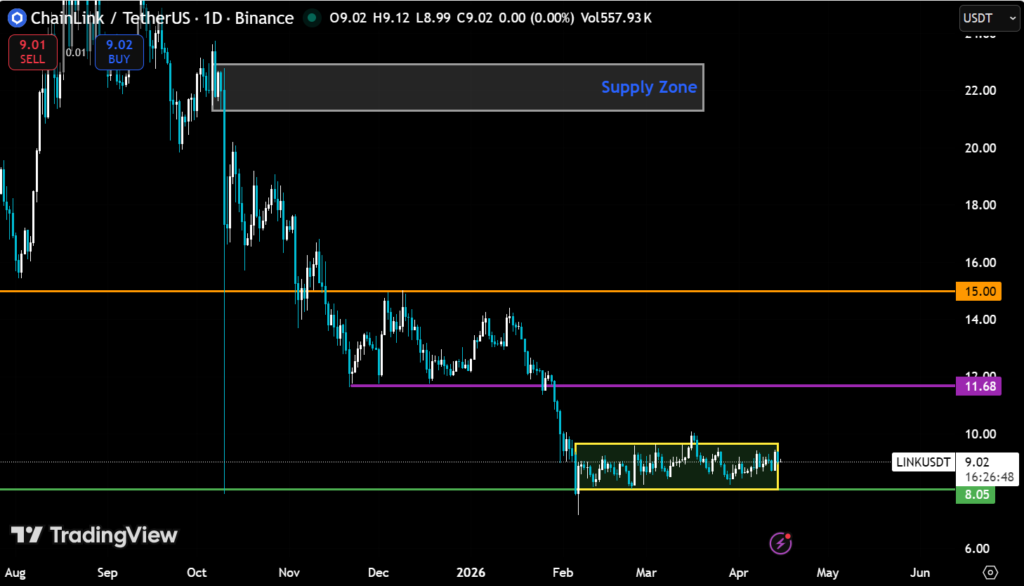
The most important observation on the asset’s daily chart is not the short-term price action but the broader structural damage that preceded the current consolidation. After trading near the upper supply zone, which spans roughly $18 to $22 on the chart, LINK entered a prolonged downtrend that accelerated sharply into early 2026. The price broke through the $11.68 support level (represented in purple), a horizontal that had been tested multiple times between November and January, as well as capitulated toward $8.05, which now represents the structural floor of the current consolidation.
The yellow consolidation box on the chart captures price action from late January through early April 2026, with LINK oscillating between $8.05 and approximately $10.00. The current candle at $9.02, with an intraday high of $9.12 and a low of $8.99, illustrates just how compressed the range has become. This reflects a market that is absorbing overhead supply from prior holders while simultaneously building a base.
For traders mapping the road ahead, there are three distinct resistance structures to clear before LINK returns to structurally meaningful price territory. The first is the immediate ceiling near $9.50 to $10.00, which also coincides with the upper boundary of the yellow consolidation box. The second is the purple horizontal at $11.68, the level that acted as multi-month support before breaking down in February; that prior support now functions as resistance and represents the most technically significant level in the near-to-medium term. The third is the $15.00 orange horizontal, a level that defines the broader prior trend structure and sits well above where price currently trades.
The $8.05 Floor and What It Represents
The green support line at $8.05 is not simply a round number or a minor swing low. It corresponds to the lowest point of the February capitulation and represents the only level where buyers have demonstrated the willingness to absorb supply at scale. Every recovery attempt within the yellow box has originated from or near this level. As long as $8.05 holds on a daily closing basis, the structure supports a continued base-building interpretation. A daily close below $8.05 would invalidate the pattern and shift the distribution of risk materially lower, with no visible horizontal support on the chart until significantly lower price levels.
The 10-week duration of this consolidation is worth noting. Extended base formations at multi-month lows, when accompanied by contracting range and declining exchange supply, tend to resolve directionally with more force than shorter consolidations. The key variable is whether the resolution comes upward or downward.
On-Chain Flows Add Weight to the Accumulation Case
The chart structure gains additional context when viewed alongside on-chain data. Approximately 1.2 million LINK moved off exchanges within a 48-hour window, according to the data as per coinmarketcap, and exchange reserves for the token have been on a declining trend. Separately, whale addresses holding large LINK balances increased, with addresses holding more than 1,000 LINK reaching approximately 25,420 an 8-month high. The total reported whale holding figure stands near 661.9 million LINK, with a reported net addition of 1.89 million LINK in the most recent measurable period.
Declining exchange reserves combined with whale accumulation is technically consistent with reduced near-term sell pressure. It does not guarantee an upward move, but it does reduce the probability that a sustained sell campaign from large holders is underway at current levels. The more meaningful risk is that whales who have accumulated at these levels choose to distribute to any strength, which is why the $10 ceiling and the $11.68 structural resistance require volume confirmation to be taken seriously as breakout levels rather than rejection zones.
The Product Catalyst: Structural Driver or Near-Term Noise?
The April 12 launch of Chainlink’s 24/5 US Equities Data Streams live across 40-plus chains and integrated with platforms including BitMEX, ApeX, and Lighter represents a genuine product development rather than a speculative narrative. The tokenized real-world asset market is estimated at approximately $27 billion as of 2026, and demand for reliable, low-latency equity pricing data in on-chain environments scales directly with that market’s growth.
For context on how product integrations translate into usage metrics, Polymarket’s adoption of Chainlink Data Streams on Polygon produced $153 million in average daily volume across 5 and 15-minute markets, $4 billion-plus in total volume, and more than $200 million in the first week of its 5-minute product alone. That volume increase represents direct demand for oracle queries and, by extension, for the infrastructure Chainlink provides.
The drawback is that product development and price performance operate on different timescales. The technical picture will not confirm a trend change until LINK closes daily sessions above $10.00 with above-average volume and then successfully defends or reclaims $11.68. Until that sequence plays out, the chart structure is a base with potential, not a breakout in progress.
What to Watch
The immediate price level to monitor is a sustained daily close above $9.50, which would begin to challenge the upper boundary of the 10-week consolidation box. A close above $10.00 on meaningful volume, not just an intraday spike, would be the first signal that the is transitioning into a breakout structure. Conversely, any daily close below $8.05 would materially change the risk picture.
Beyond price levels, the sustained decline in LINK’s exchange reserve balance is the on-chain metric most worth tracking on a daily basis. If outflows reverse and exchange balances begin rising while price stalls near $9.50 to $10.00, that combination would suggest distribution rather than accumulation, a meaningful warning for the near-term setup.
The $11.68 level remains the most important structural milestone. Until LINK clears and holds that level, the chart reflects a recovery attempt within a broader downtrend, not a confirmed trend reversal.