



Senator Elizabeth Warren said SEC Chair Paul Atkins may have misled Congress after newly released agency data showed enforcement activity fell to its lowest level in more than 20 years.
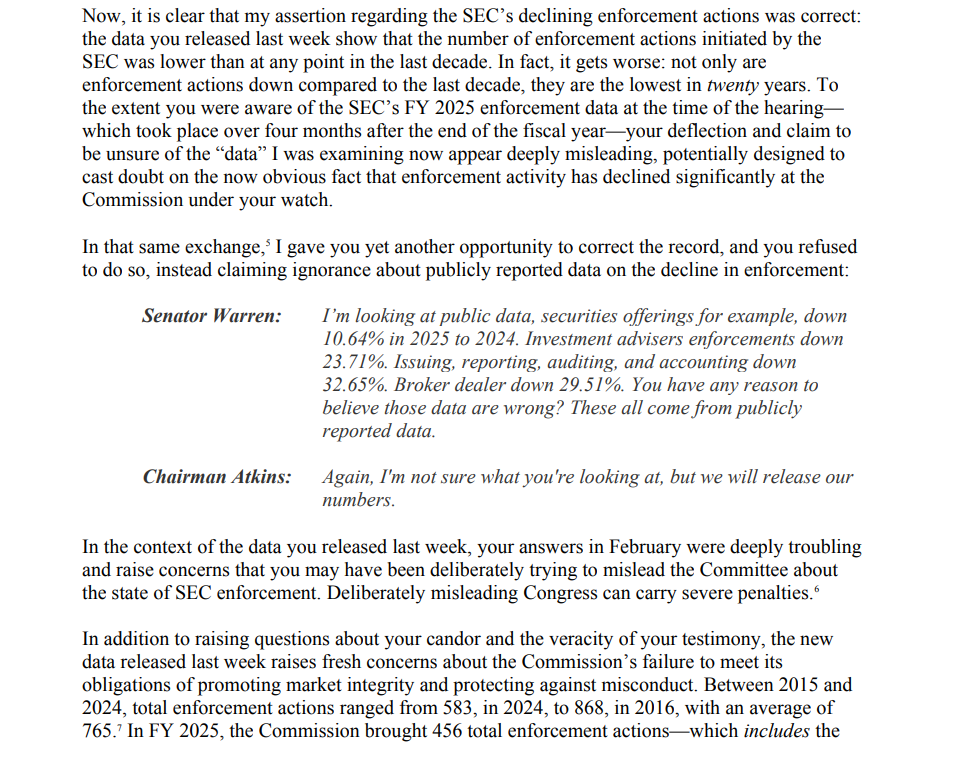
In an April 15 letter to Atkins, Warren said the SEC’s fiscal 2025 enforcement data contradicted his testimony at a February 12 Senate Banking Committee hearing. At that hearing, after Warren said public data showed the SEC had brought fewer new enforcement actions than at any point in the last decade, Atkins replied that he was “not sure what data” she was referring to.
Warren Points to Hearing Remarks
Warren, the top Democrat on the Senate Banking, Housing, and Urban Affairs Committee, said the SEC’s April 7 data release showed enforcement activity declined 20% and confirmed that actions initiated by the agency were lower than at any point in the last decade and the lowest in 20 years. She wrote that, if Atkins knew those figures at the time of the hearing, his answers now appear “deeply misleading.”
She quoted Atkins as saying: “I’m not sure what data you’re looking at because we actually haven’t released our data yet, but I would disagree with your premise.” Later in the same discussion, after Warren cited public figures showing declines in several enforcement categories, Atkins said: “Again, I’m not sure what you’re looking at, but we will release our numbers.”
Drop in Cases and Relief
Warren said the SEC brought 456 total enforcement actions in fiscal 2025, including 200 filed in the first quarter under former Chair Gary Gensler. Between 2015 and 2024, total annual actions ranged from 583 to 868, with an average of 765, she wrote.
Her letter said the SEC reported $17.9 billion in monetary relief, but about $15 billion of that came from a Ponzi scheme case first filed in 2009. Excluding that case, Warren said the agency secured about $3 billion, the lowest in five years. Money distributed to victims fell to $262 million from $937 million in fiscal 2022, she wrote.
Warren Gives Atkins Until April 28 to Respond
Warren asked Atkins to answer by April 28 whether he knew when he testified that enforcement actions had fallen to a 20-year low, and how the drop in cases and penalties fits with the SEC’s mission. She also pointed to staffing losses in the enforcement division and the resignation of enforcement director Margaret Ryan as signs of broader strain inside the agency.
A Shift From the Gensler Era
The drop in SEC enforcement has drawn sharp attention as it marks a clear break from the approach taken under former Chair Gary Gensler, whose time leading the SEC was defined by aggressive use of the agency’s enforcement powers.
Under Gensler, the SEC built a reputation for bringing cases across many areas of global markets, from public-company disclosures and accounting issues to broker-dealer conduct, investment advisers, and crypto.
That changed under Atkins, whose approach appears less focused on bringing a high number of cases and more willing to talk first and enforce later than the prior leadership.
That shift has become harder to ignore as the agency’s latest figures show a steep decline in actions, reinforcing critics’ view that the SEC is no longer policing the markets with the same intensity it did under Gensler, a change that could carry both benefits and risks for markets.