





The BNB Chain has just announced the launch of the Osaka/Mendel hard fork, a network upgrade designed to refine execution stability and finality after the chain achieved sub-second block speeds. Rather than pushing block times further, this hard fork will focus on improving the chain’s performance under real-world conditions by tightening the gas-for-block calculations, imposing hard caps on certain heavy operations, and improving the reliability of transaction confirmations.
What the Hard Fork Brings
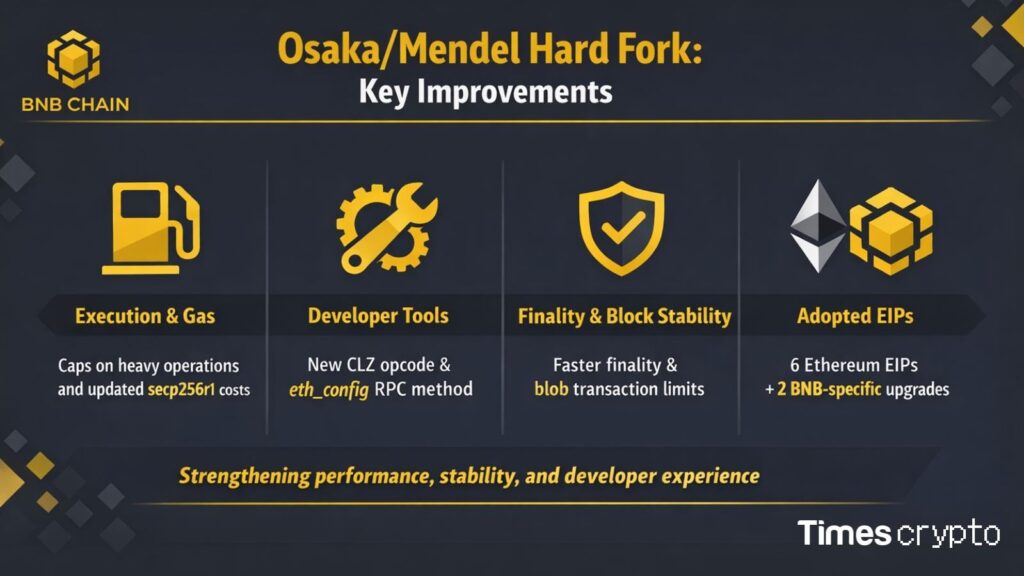
The Osaka/Mendel hard fork adopts six Ethereum Improvement Proposals (EIPs) that will enhance the BNB Chain. They include: EIP-4803 (capping gas limits for transactions), EIP-5656 (providing a new MCOPY operation code to efficiently copy data between memory regions), and changes to how gas costs are calculated for secp256r1 cryptography [a 256-bit elliptic curve recommended by the National Institute of Standards and Technology (NIST) for digital signatures and key exchange] to improve integration between the BNB Chain and other blockchains.
There are additional two upgrades specific to the BNB Chain: Blob transactions (large packets of data that can be included in Ethereum blocks) are now limited by block number to prevent data-heavy blobs from degrading performance, and fast finality is enhanced using an ‘in-memory voting pool’, reducing confirmation latency.
In addition to those three EIPs, the hard fork will also create an upper bound on modular exponentiation (which is a gas-intensive precompile), provide a new count leading zeros (CLZ) opcode for developers, and create a new JSON-RPC method (the eth_config method) for builders to obtain better visibility into the configuration of nodes. Finally, the cap on the size of each block will help to ensure that all transactions receive the same level of processing speed during peak or high activity.
Importance of These Improvements
With BSC already processing around 0.75-second blocks, even small inefficiencies can cause friction. The Osaka/Mendel hard fork will eliminate this issue by creating predictability with respect to costs of gas, stability of execution, and speed of finality without changing the way applications are built. This means that users will experience fewer delays due to unexpected occurrences, and, for developers, this will make your gas models simpler and reduce the likelihood of edge failures.
Future Plans
Osaka/Mendel will take effect on April 28, 2026: All node operators will need to update their operating software before that date. BNB Chain stated that future upgrades will also continue to improve performance, but Osaka/Mendel is the first step in moving from pure speed to reliability that can be matched by a production tier.


