




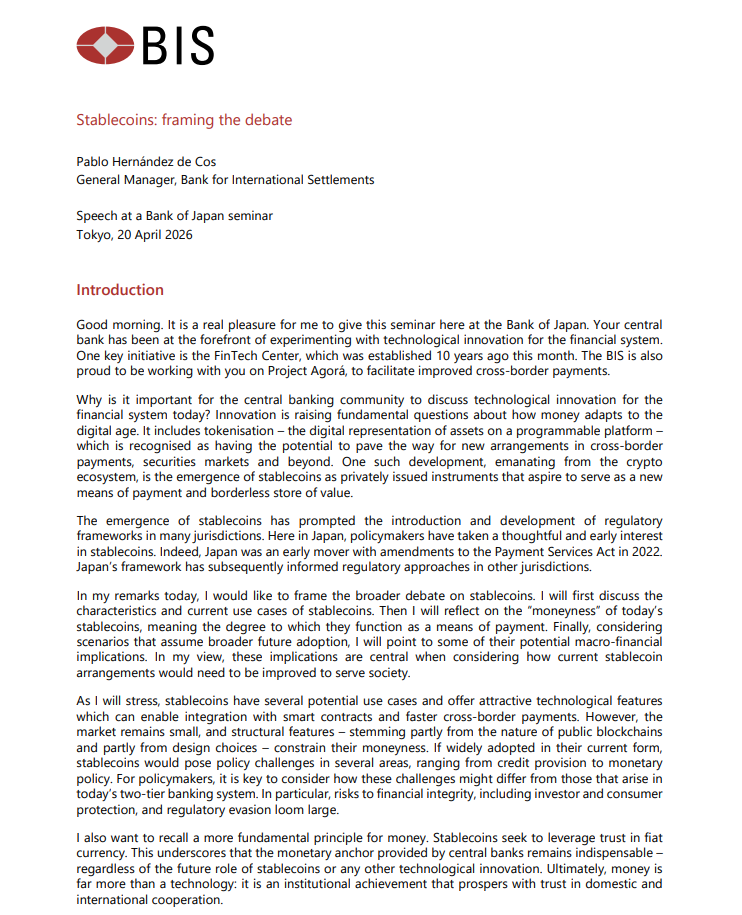
Stablecoins may offer faster cross-border payments and new uses in tokenized finance, but in their current form they remain too limited and risky to serve as a widely trusted form of money, BIS General Manager Pablo Hernandez de Cos said on Monday.
Speaking at a Bank of Japan seminar in Tokyo, De Cos said privately issued stablecoins had attractive technological features, including programmability and the ability to settle transactions automatically, but their role in the real economy remained modest.
He said the global stablecoin market, at about $315 billion in early April, was still small compared with traditional banking deposits, and most usage remained concentrated inside the crypto ecosystem rather than in mainstream payments. Annual transaction volumes may appear large, he said, but payment-related flows represented only a small share of activity.
Regulation Alone May Not Be Enough
De Cos said stablecoins had been promoted as a cheaper and faster way to move money across borders and as a digital route into U.S. dollars, especially in economies where local currencies are weak.
He argued that adoption has remained narrow even where dedicated rules are in place, pointing to Japan, where early reforms to the Payment Services Act still did little to build a meaningful market for yen-backed stablecoins, while the strongest growth came instead from dollar-linked coins operating outside major regulatory regimes.
That, he said, raised doubts over whether regulation alone could bring stablecoins fully into the financial mainstream.
Why “Moneyness” Matters
The report argues that today’s stablecoins still fall short on “moneyness” because they do not fully meet two core conditions of money: singleness and interoperability. In other words, money should be accepted at par and move seamlessly across platforms and networks.
He added that unlike bank deposits, stablecoins do not settle on central bank balance sheets, so redemption at face value is not guaranteed in the same way, while their use across blockchains can fragment liquidity and create added operational and security risks.
De Cos said these weaknesses limit stablecoins’ ability to function as a reliable means of payment and could keep them confined to a niche role unless their design improves.
Broader Risks if Adoption Grows
If stablecoins were adopted on a much larger scale, he said, the consequences could stretch far beyond crypto markets.
A shift away from bank deposits could raise banks’ funding costs and curb lending, while greater reliance on non-bank finance could make credit more cyclical in times of stress. He also warned that runs on stablecoins could spill into traditional markets through forced sales of reserve assets.
The biggest concern, however, was financial integrity. Stablecoins circulating on public blockchains and through unhosted wallets can weaken anti-money laundering and counter-terrorism controls, he said, adding that illicit actors continue to adapt even as major issuers freeze suspicious funds.
De Cos said central banks should keep exploring ways to bring the technological gains of tokenization into the existing financial system, including through tokenized deposits and projects such as the BIS-led Project Agorá, while preserving central bank money as the anchor of trust.


