



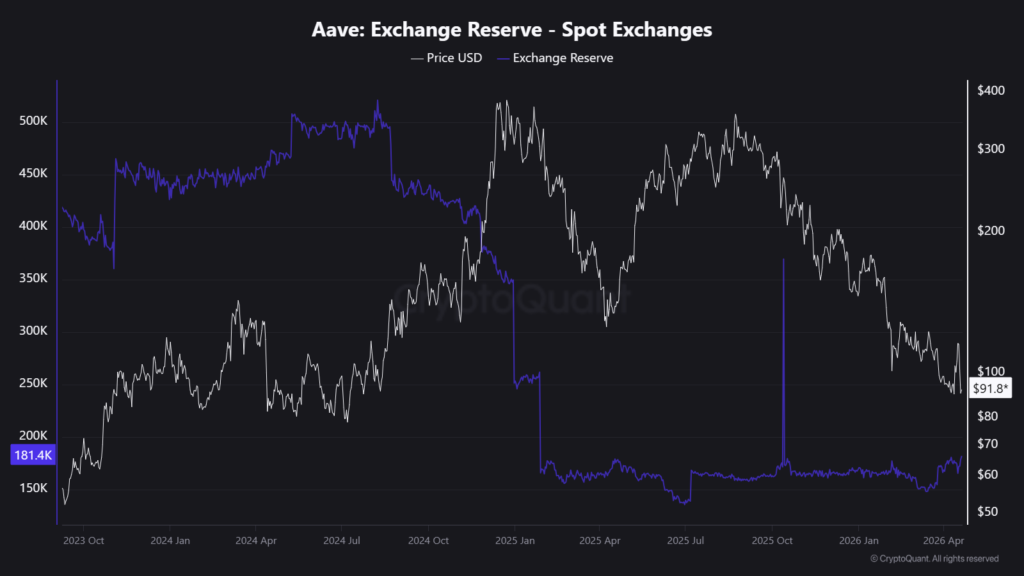
The Aave spot exchange reserve has risen to 181,400 tokens. This level was last achieved in early November. However, this coincides with the AAVE token trading at $91.50 that is a considerable drop from the $220+ levels achieved merely weeks ago. This combined factor is more informative than both metrics individually. Declining prices with rising reserves provide one of the strongest signals that can be obtained on-chain for tokens leaving cold storage to move onto exchanges for sale, not acquisition.
But the chart tells a more complicated story than simple sell pressure. Understanding why those tokens are moving requires looking at what happened to Aave V3 in the weeks prior.
What the Chart Actually Shows
Throughout late October and into mid-February, Aave’s exchange reserve range remained fairly constricted between 163K and 170K (choppy range). While price was on a decline from the $180s down into the $100s-$120s range during the same time, reserve levels remained mostly steady. This is somewhat significant: the price was dropping, but users weren’t moving to exchanges.
That trend faltered in March. Shortly after around March 16th (the first of the two inflections pointed out in the chart), reserves actually started rising noticeably, reaching the $175-177k mark as the price recovered briefly to roughly the $175-$180 area. Then came the second inflection in late March or early April; reserves actually experienced a quick, accelerated surge. By mid-April, reserves have reached 181,400 now with the price sitting at $91.50.
The split here is clearly visible. Price broke new lows within this entire window. Reserves, the exact opposite, reached new highs. This formation is a distribution pattern, and the size of it (around 12-15,000 AAVE added to spot exchange as opposed to November’s values) represents significant dollar value at any price greater than zero.
The Kelp DAO Attack: What Actually Happened to Aave
The context behind this reserve movement is critical. The $292 million exploit targeting Kelp DAO’s rsETH created approximately $200 million in bad debt directly on Aave V3. Bad debt at that scale isn’t an abstraction and it means the protocol absorbed losses that didn’t belong to any single borrower, leaving the system holding positions it cannot close cleanly.
Also, the immediate mechanical consequence was also quite significant. The Aave V3 had a usage rate as high as 100% of total pool liquidity. If the usage is at 100%, lenders will not be able to withdraw their funds. It effectively becomes a blockade on the exit side if considered at the protocol level, the one that a rational agent would actively avoid to move funds out of it or send them to an exchange before they are stuck.
That utilization spike precipitated a $7.8 billion outflow from the protocol. To put that in perspective: Aave was the largest lending protocol in DeFi, and the respective outflow is not a routine deleveraging event. It reflects a genuine loss of confidence in short-term liquidity access.
Why This Is More Than Temporary Selling Pressure
The standard reading of rising exchange reserves is “bearish tokens are being moved to sell.” The same thinking is accurate here, but incomplete.
It is now important to also shift focus to the second-order effect. The protocol activity is the major metric that acts as Aave’s revenue model. In addition to this, borrowing and lending volumes generate fees that flow to the protocol treasury and AAVE stakers. A ~$7.8 billion reduction in TVL precisely limits that fee generation and that also weakens one of the fundamental arguments for retaining AAVE as a yield-bearing asset.
The reserve chart is, in this sense, a lagging indicator of that sentiment shift. It also familiarizes the outcome of decisions that were made as soon as the attack information had become clear.
Price Levels and Where Things Stand
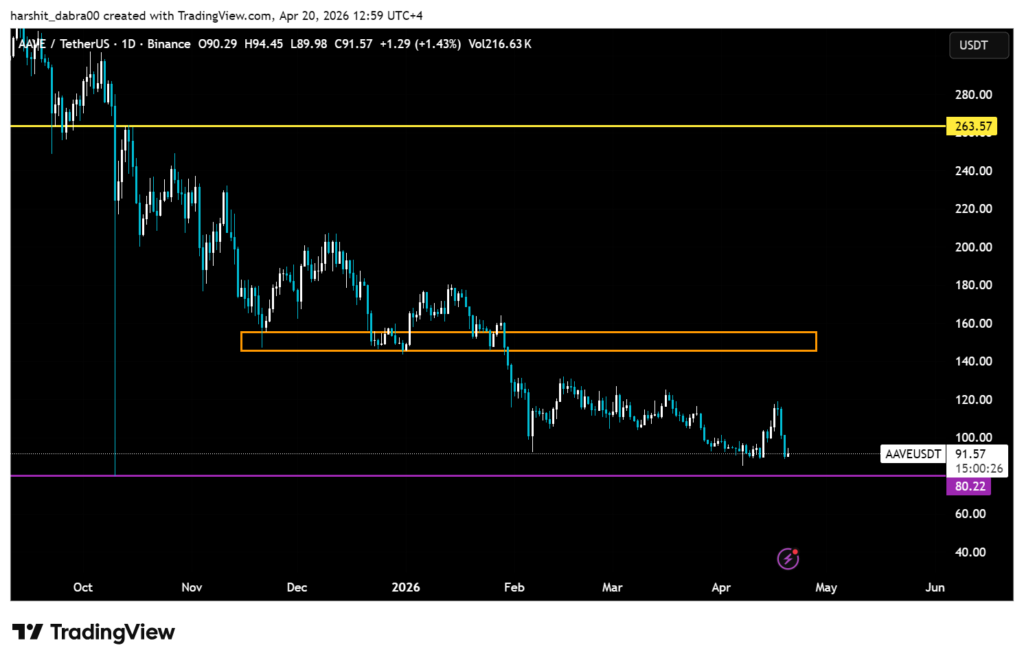
At $91.5, AAVE is trading near the bottom of its entire multi-month range on this chart. The November lows appear to have been around $95-$100 based on the chart data. If $91 represents a decisive breakdown below that support, the next logical question is what, if anything, provides a structural floor.
The reserve level is now sitting at 181,400 and represents the chart high. Price is at a chart low. There’s no divergence developing yet and no sign that reserves are starting to fall as price stabilizes, which would be the early signal of distribution exhaustion.
What traders and liquidity providers should watch is whether exchange reserves begin declining without a corresponding collapse in price. That would indicate that the selling wave is clearing. Conversely, if reserves continue rising while price holds near $91 or breaks further, the distribution phase hasn’t found its equilibrium.
The Structural Question Aave Has to Answer
In a positive framing, the ability of Aave to handle $200M of bad debt while still operating shows how Aave is designed. Most of DeFi operated normally, which shows that it did not fail. The 100% utilization situation brought to the surface the fact that sophisticated users know now that concentrated attack vectors based on what collateral is accepted can turn the mechanics of the protocol against its liquidity providers. As a part of it, Stablecoin pools were also frozen.
The $7.8 billion outflow suggests that awareness is already priced into behavior, even if it isn’t fully priced into AAVE’s token yet.