




Pi Network just hit another milestone with the release of its Protocol 21 upgrade. On the technical side, it’s a genuine leap forward; network stability is up, scalability has improved, and Pi’s core is better positioned for the big stuff still on the horizon, like smart contracts. So, you’d think this kind of progress would send the price flying, or at least make a meaningful dent in the chart.
But if you actually check the numbers, the excitement hasn’t quite made it to the market. Right now, Pi Coin is trading at about $0.167. Over the last month, Pi has dropped about 13.7%. For anyone holding over the past year, it’s been brutal: the token lost nearly 77% of its value. Compare that to the all-time high of $2.99, and it’s still languishing more than 94% below.
Why the PI Coin Price Isn’t Responding to the Upgrade
Here’s the crux: there’s a clear disconnect between Pi’s technical achievements and its actual price action. Sure, the Protocol 21 upgrade speeds up transactions, makes the infrastructure more reliable, and sets the scene for real innovation. But the optimism isn’t spilling over into real engagement. The upgrade feels a bit like fixing the roof on a house nobody’s living in. There just aren’t many mainstream apps built on Pi yet. Without a killer app or broader adoption, no real buying pressure builds up.
That’s why PI coin keeps circling the same price range. Over the last week, it’s bounced gently between $0.164 and $0.171.
Trading volume tells the same story. A daily volume of $15 million is unimpressive for a project of this size. People just aren’t rushing in. Buyers seem hesitant, and sellers have enough influence to cap any rallies before they start.
The upgrade is substantial, no doubt. But traders aren’t betting big on promise alone; everyone’s waiting to see if these technical gains actually turn into something useful.
A Market Still Driven by External Forces
Right now, PI’s price is not moving on its own story. It is largely reacting to the broader crypto market movements, especially that of Bitcoin (BTC). And you see this pattern all the time with assets that haven’t built their own solid fanbase or unique demand. When Bitcoin climbs, PI Coin usually tags along, but it doesn’t pack quite the same punch; its gains are usually smaller. On the flip side, when Bitcoin stumbles, PI Coin often dips more sharply.
In the short term, as long as the PI token holds above the $0.16 level, there is a chance for a gradual move toward $0.17. However, the rally is unlikely to be strong unless it is supported by rising volume and a favorable market environment.
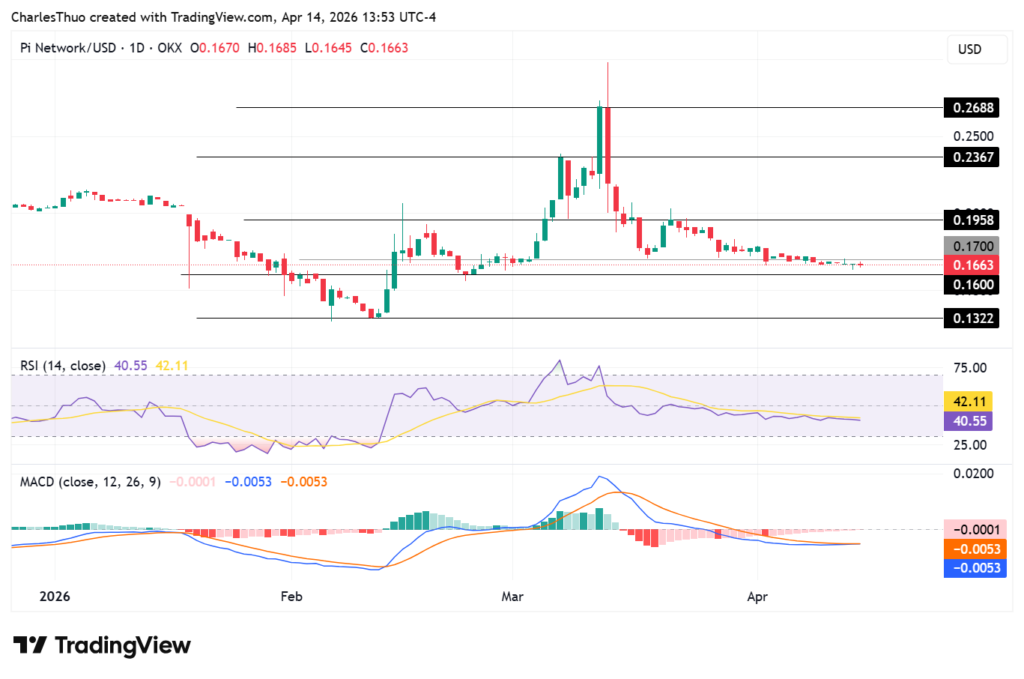
On the downside, a break below $0.16 could trigger a quick drop toward $0.1322.
Exhaustion Signs Appear, But No Breakout Signs In Sight
Despite the broader downtrend, there are early signs that the selling pressure may be easing. It has been shown that the token’s price movements over the past few days presented less volatility, and the market appears to be forming a base around $0.16. This kind of stabilization often comes before a larger move, though, like in any market, it is not always guaranteed.
Some technical indicators, like the RSI and MACD, are also suggesting that momentum is no longer as weak as it was earlier this year. For instance, these signals remain tentative. With no clear surge in demand, any upward movement could fade quickly.
For a more convincing shift, PI needs to break above $0.17 and hold above that level. More importantly, it needs to do so with stronger trading activity. A breakout without volume would likely be short-lived.
What Comes Next for Pi Network
Pi Network is still in a building phase. The Protocol’s 21 upgrade, along with new developer tools like testnet access, shows that the project is moving toward a more functional ecosystem. These are necessary steps, but they are not the final destination.
The next major moves will likely come from the introduction of novel smart contracts and the launch of real applications that people actually care about, adding use cases to the network usage. That is when demand can start growing in a meaningful way. Until then, the market may continue to treat Pi as a secondary player, moving in line with broader trends rather than setting its own direction.


