





MVRV is sitting around 1.40 and all the main exchanges have funding rates at negative (-0.0111 at the lowest recent value, with a continuing strong short bias for much of February, March, and April). The adjusted SOPR has been below and stands close to the 1.0 breakeven since the beginning of February, with the current reading of 0.99. These three stats together suggest one thing and one thing only: this is an early-cycle market.
MVRV at 1.40: What the Ratio Actually Represents
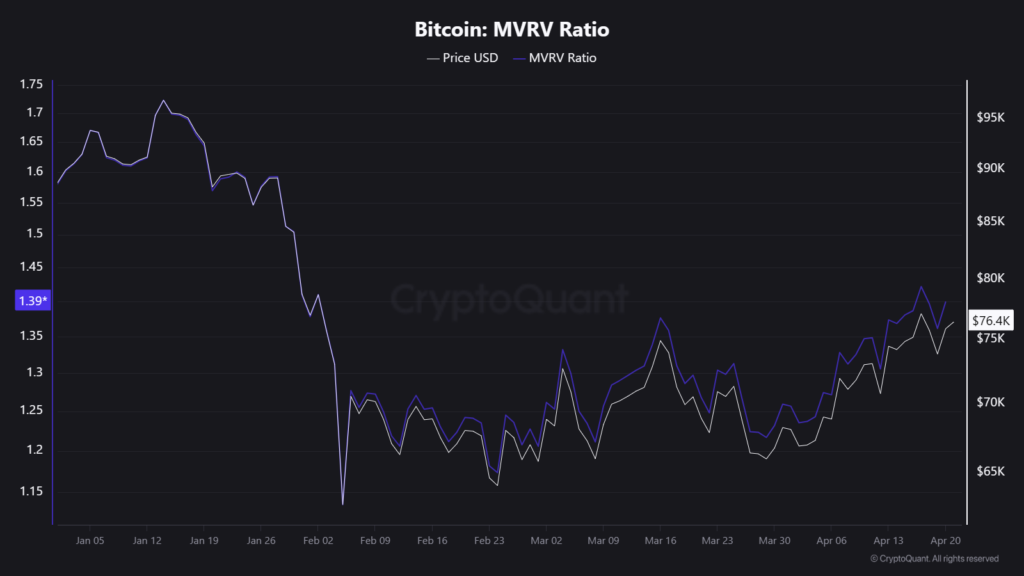
MVRV measures bitcoin’s market cap relative to its realized cap, or what the market thinks bitcoin is worth, versus what investors actually paid. A reading below 1.0 indicates when the average coin is losing money. Readings above 3.7 historically precede cycle tops. The current market at 1.40 is a midpoint repricing zone above capitulation levels and is far from a market-topped valuation we have seen in the past.
The 1.4 level becomes crucial to note, as it’s not the absolute number. Bitcoin saw a fall from $95k down to this $76.3k territory; it wiped out a ton of retail positioning and created massive bear market narratives but MVRV didn’t break and held up in mid-cycle. The average holder is still underwater. They aren’t waterlogged enough to aggressively realize profits.
Valuation floor is one of the main factors here. Previously, a $65k-$70k price would be in MVRV at 1.0, meaning it’s at realized cap. This is where the ratio historically bottoms during intermediate cycle slumps. Price at $76.3k is well above that level, indicating this is more a phase of compression than resetting.
Funding Rates: The Short Side Has Been Dominant for Three Months
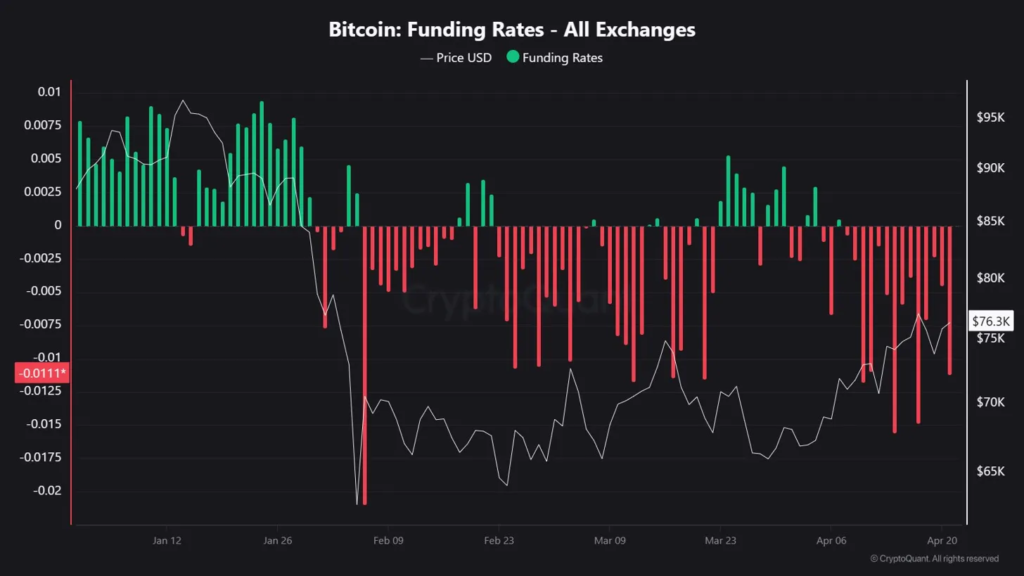
The funding rate chart essentially tells a narrative that lasts throughout almost all of Q1 2025. After late January, there were no longer green bars but a near-complete takeover by red bars. A negative funding rate points out that perpetual shorts are paying to stay in the market, indicating the existence of a structurally bearish market sentiment in derivatives.
The largest negative reading on the chart was -0.0111 at the latest data block. The baseline of January approaching $95k displayed a steady stream of positive funding from +0.005 to +0.009 indicating long leverage positions in the euphoric period; those times are over, and structurally this market has turned around.
There are two things that sustained negative funding does together. They put in place a technical short squeeze risk if the price whips back upward as the cost to hold shorts rises and are able to be leveraged to further the move. More importantly, it indicates there are no speculative actors prepared for any kind of rebound, a distinct problem from what the MVRV alone would imply. Therefore, that common risk of over-leveraging to the long side before a major flush isn’t here.
Adjusted SOPR: The Loss-Selling Signal
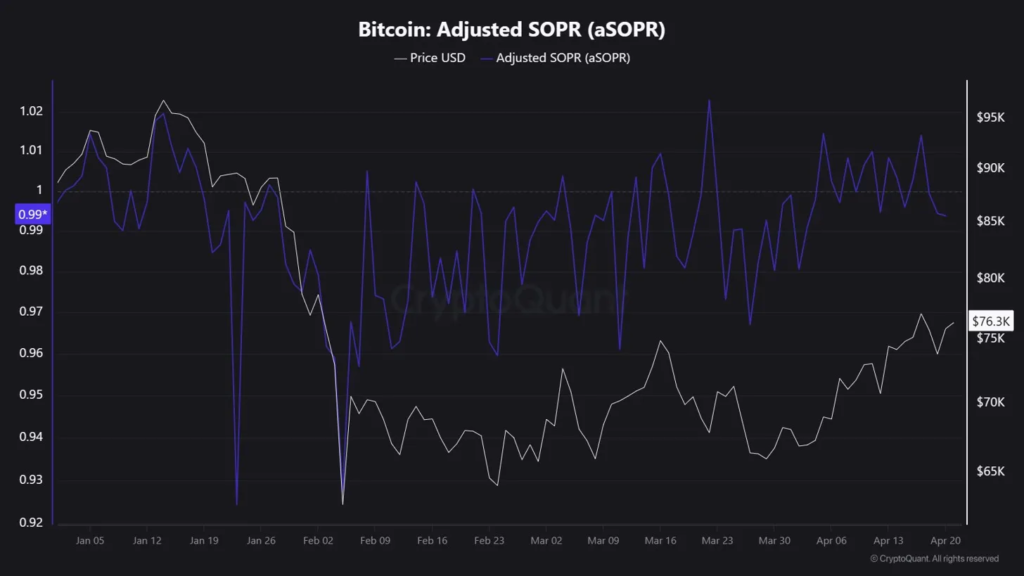
aSOPR removes the short-term fluctuations of the asset’s transactions and therefore gives a more economically significant view of spending behavior. Above 1.0 indicates profitable net spending, and below 1.0 suggests the active spender group is in loss.
Since the start of Feb, aSOPR has spent most of its time trending between the zones of 0.96 and 1.01, dipping near 0.926 on Feb. 3, one of the biggest single-day drops in the whole range. A current value of 0.99 is fractionally below the zero line and this doesn’t reflect panic. The following trend isn’t distribution either.
The above is a chart showing the trend of slow selling. There is usage of coins but they’re being spent at thin losses or minimal gains and none of this is the rapid profit-taking that characterized late-cycle distribution. Late-cycle spending resembles aSOPR, printing persistently above 1.02-1.05 with bunches of significant profit taking, but the chart doesn’t reflect that. What’s apparent are sellers giving up at cost or selectively trimming small losing positions.
When aSOPR gets above and successfully holds above 1.0. Furthermore, the shift from spending less to more than the people make is a valid sign of a local bottom. We are not quite there yet, but being at 0.99 versus 1.0 is not the crisis level.
The Convergence: What Three Indicators Highlight
Any of these metrics could be reasoned to support the bearish side of it. The value of MVRV of 1.40 could mean “plenty of room to go down.” Negative funding could mean “the market deserves to be bearish.” aSOPR under 1 could mean “holders have lost conviction.” That’s one interpretation.
The mid-cycle resets don’t tell the market participants when they’re going to occur. What they actually resemble is a price falling 20% with bearish sentiment and shorts pushing back and holders taking minor losses. There is neither the structural signal for a true top nor the capitulation signal that normally indicates a true bottom. This is the awkward midpoint, and historical data suggests this middle ground trends higher than a bear would be willing to believe.
There is one tension worth noting. Price at $76,300 is not a screaming undervaluation MVRV would need to approach 1.0 for that reading. The setup is more nuanced: the market isn’t cheap enough for uncritical accumulation, but it’s not expensive enough to warrant structural bearishness. The short-side dominance in funding rates and the marginal aSOPR readings both suggest the majority of speculative positioning is already leaning bearish, which historically is not the alignment that precedes large sustained downside moves.
There are some Specific nuances to the above. $76,300 is not an absolute signal of undervaluation; the MVRV would have to be around 1.0 for that. The setup is a lot subtler and the price is not undervalued enough to just ape in to, yet not expensive enough to turn technically bearish. The bear funding set up and marginal aSOPR readings both signal that speculative players are already on the bearish side, which has not in the past signaled a massive, sustained bear trend.
What You Should Know as a Trader
The carrying cost of shorts is increasing for traders observing the derivatives space as funding remains negative. With each additional day of sideways or higher price action, short positions become more expensive. While a funding squeeze is not an inevitability, the mechanical condition exists.
Long-term position trades: A range of MVRV between 1.0-2.0 while aSOPR is near 1.0 historically represented an area where accumulation is better than reactive trades. The distribution phase, which has the nature of the long-term holder selling into pumps, doesn’t look like that at all. MVRV is above 3.0, funding is consistently positive and aSOPR has been printing above 1.02 for multiple weeks.
None of these indicators point towards a specific price target. The current onchain data for the largest cryptocurrency doesn’t support one. The kind of read it supports is of the current regime focused on mid-cycle, not top, and the speculative market is bearish out of proportion to the conviction level supported by the backdrop of valuations.


