
AAVE price has stayed above $92 even as Aave faces a sharp drop in locked assets and weaker protocol activity. In recent days, the DeFi platform lost 33% of its total value locked, although the token has not been subjected to a more significant sell-off. That contrast has drawn fresh attention across the market. It also highlights a growing split between platform stress and token resilience.
Aave Faces Pressure After Market-Wide DeFi Shock
Aave has entered a difficult stretch after the recent Kelp-related exploit unsettled the broader DeFi market. Activity across the protocol has slowed, and capital has moved out quickly. According to the figures provided, Aave’s TVL now stands at $16.7 billion. That marks a steep fall from the $34 billion level seen in January.
The drop in TVL points to more than a short burst of caution. It shows that users have turned defensive after a major security event touched several connected platforms. Besides, the decline in on-chain revenue adds another layer of concern. Revenue fell from $1.1 million in early February to $625,000 on Monday.
That shift matters because it suggests reduced borrowing, lower utilization, and softer overall demand. Consequently, Aave now faces two problems at once. It must restore confidence in risk controls while also reviving normal activity.
Kelp Exploit Adds New Stress to Aave’s Ecosystem
The recent exploit involving Kelp DAO’s rsETH token has added serious pressure to Aave’s markets. The attack centered on a LayerZero V2 bridge between Unichain and Ethereum. Hackers used that weakness to withdraw 116,500 rsETH without a matching burn on the source chain.
That move quickly created trouble for lending markets tied to those assets. The stolen assets later served as collateral on Aave V3 deployments across Ethereum and Arbitrum. Borrowers then opened positions against WETH and wstETH. As a result, Aave faced immediate risk exposure through linked collateral and loan activity.
Aave DAO moved fast to limit the fallout. It froze rsETH and wrsETH reserves across several V3 markets. Additionally, it set loan-to-value ratios to zero for those assets. The DAO also adjusted WETH interest rates and restricted borrowing activity in key pools.
Those actions helped contain the immediate damage. However, they did not erase the wider concern. LlamaRisk estimates suggest possible bad debt could range from $123.7 million to $230.1 million. That range depends on how losses spread across affected positions.
Governance Friction Deepens the Downturn
The current market hype has not come in a vacuum. Aave has been experiencing internal governance tensions over the past few months. Arguments over revenue distribution, fee structure, and the increasing influence of Aave Labs have been a burden to the mood. In addition, such disagreements have resulted in some high-profile exits.
BGD Labs and Chaos Labs, as well as the Aave Chan Initiative, have all since pulled out during that time of friction. The latter is important since governance stability is likely to influence the trust in DeFi protocols. The coordination problem is seldom solved by technical strength alone. Therefore, the recent drop in Aave TVL is indicative of both external and internal shock.
This mix creates a more complex recovery path. Security responses may calm near-term fear. Yet stronger governance alignment may matter just as much in the weeks ahead. Aave still holds a major place in DeFi. Even so, the protocol now needs a clearer direction to keep users engaged.
AAVE Price Stays Firm Despite Weak Fundamentals
Even with those setbacks, AAVE price has stayed relatively firm. The token trades above $92 and has posted a modest daily gain. That move stands out because the platform itself has seen heavy pressure. Significantly, the market has not treated the TVL drop as a full collapse in long-term value.
Such resilience can be an indicator of confidence in the speed and positioning of Aave in the market. The sell-off can also be deemed as an overreaction by traders after a prolonged lapse of weakness. In addition, tokens in DeFi can occasionally stabilize prior to protocol measurements turning around. Price tends to respond to expectations and not necessarily to date information.
Still, the market has not confirmed a clean turnaround. AAVE price remains under the 20-period, 50-period, and 100-period exponential moving averages on the four-hour chart. That setup shows continued near-term pressure.
Technical Signals Show a Fragile Recovery Attempt
The technical outlook implies that AAVE price is possibly attempting to establish a floor. The Relative Strength Index is close to 40 on the four-hour chart. The Stochastic Oscillator has approximately 15. Those readings indicate conditions that are oversold, but may not ensure a long-term recovery.
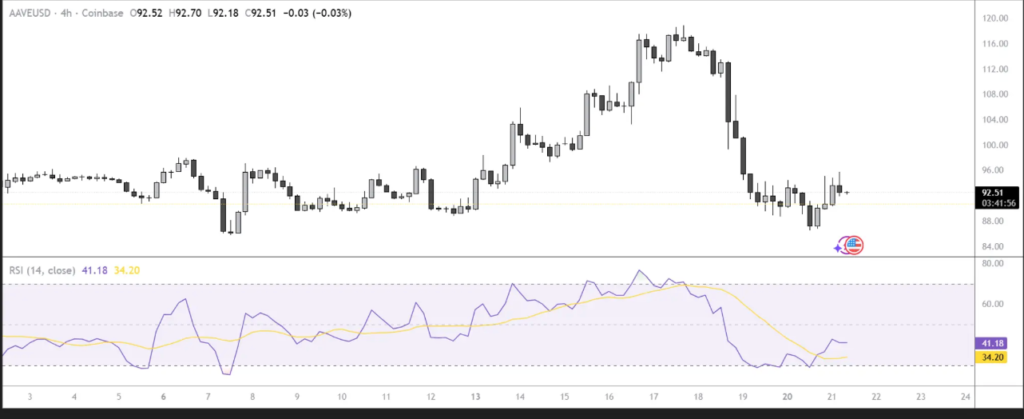
AAVE/USD 4-hour price chart sourcer: TradingView
The key level for bulls sits near $87. If AAVE price keeps that support intact, the token could push toward $98. After that, the next targets sit around the 50-period EMA at $105.22 and the 100-period EMA near $121.46. A stronger breakout could then bring $132.12 into view. The major ceiling near $182.21 would remain the bigger long-term barrier.
On the downside, support remains close and important. Immediate support sits around $87.30, with stronger demand near $77.11. If AAVE price loses its current footing, sellers could test those areas quickly. Consequently, the next few sessions may shape the near-term trend.
The daily chart is a bit more toned. The price of AAVE has resumed trading above the middle Bollinger Band at about $97.11. That change indicates that sentiment is better in the short-term. The previous high Bollinger band of 111.78, however, is the new significant resistance area. The broader-based floor of support is still determined by the lower band of about 82.45.
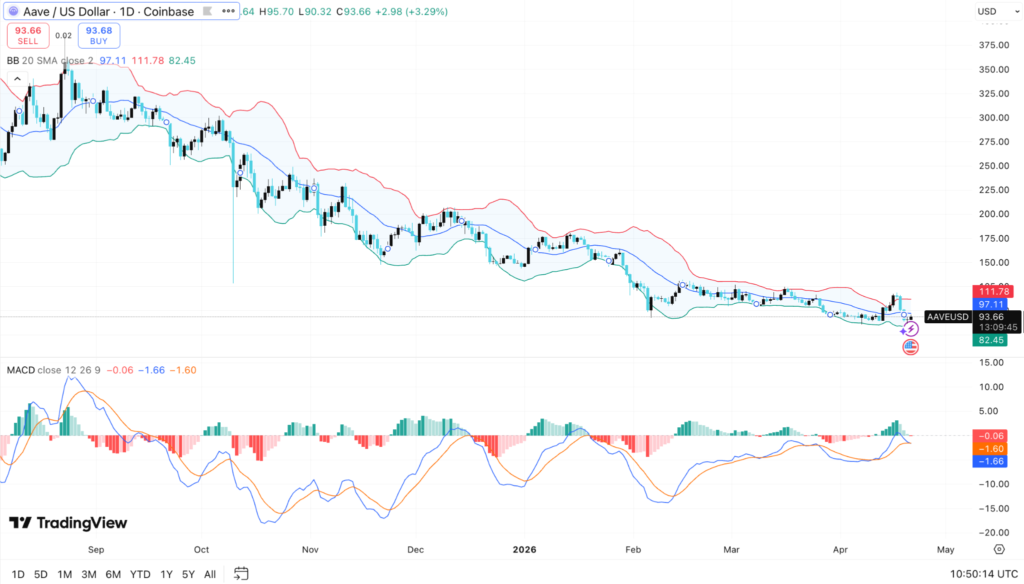
AAVE/USD 24-hour price chart source: TradingView
The MACD also displays premature recovery. The histogram became positive in the past few sessions, which is an indication of waning bearish pressure. The MACD lines are, however, close. Momentum is still weak, that way. Customers should have more follow-through to ensure a larger recovery.
Final Take
Aave now stands at an important turning point. The platform has absorbed a major external shock while dealing with internal governance strain. At the same time, AAVE price has shown a degree of resilience that many expected to fade. That split makes the current setup especially notable.
Over the short term, two things are likely to be followed by market players. First, they will monitor the stabilization of TVL following the emergency measures. Second, they will observe how the AAVE price is able to retrace resistance at over $97 and then $100. Additionally, a shift towards $111 would bolster the argument of a broader recovery.