





Government Bonds as Collateral: Japan is moving forward with the integration of blockchain within its traditional financial systems. A consortium of participants, including Mizuho Financial Group, Nomura Holdings, and Japan Securities Clearing Corporation, has started a Proof-of-Concept (PoC) trial to use the Canton Network, a blockchain designed specifically for institutional finance, in order to conduct transactions involving Japanese Government Bonds (JGBs).
How the PoC Works
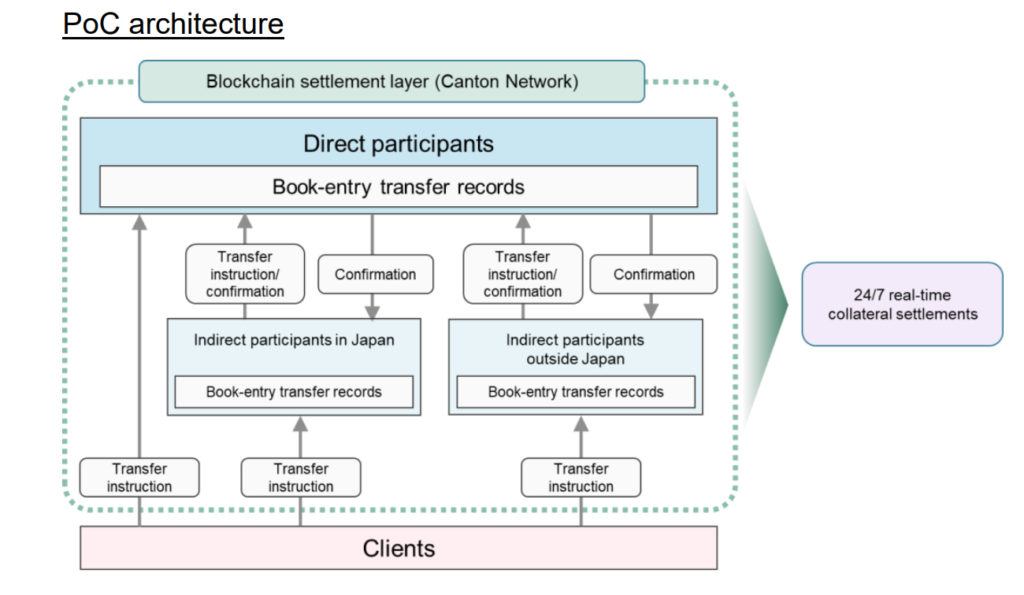
The PoC trial will determine whether it is practical to use blockchain technology to facilitate the transfer of rights for JGBs (which are governed by the Book-Entry Transfer Act of Japan), and to update the Book-Entry records without requiring the use of paper-based documentation. The consortium plans to combine its existing systems with the Canton Network in order to evaluate the ability to conduct sophisticated, real time collateral transactions on a 24/7 basis, while remaining fully compliant with both the laws and regulations that govern JGB transactions.
In addition, the PoC trial will also include a study on the feasibility of using the Canton Network for cross-border transactions that involve participants who are located both inside and outside Japan, including clearance houses, institutional investors, clients, and agents. The analysis will identify the need to amend any relevant internal rules and regulations, and will assess functional modifications that will be necessary to commercialize the use of the Canton Network.
Government Bonds as Collateral: Why It Matters for Japan’ Financial Space
JGB’s are considered “acceptable collateral” by many institutional investors overseas and around the world. Digital assets are developing quickly in the U.S. and other jurisdictions. The Japanese government sees the need for JGBs to remain available and liquid in a digital environment to compete globally with other countries’ financial markets.
There are many administrative functions related to distributing and substituting government bonds as collateral on a blockchain that can be streamlined by having a broader acceptance (thus increasing operational efficiency) and reducing costs for both investors and financial institutions alike.
The Financial Services Agency of Japan (JFSA) selected the PoC to receive funding through the JFSA’s Payment Innovation Project in February 2026. It will work to better understand the relationship between the use of blockchain tech for collateral management and existing regulatory legal frameworks (e.g., Book-Entry Transfer Act).
What’s the Future of the Japanese Crypto Industry
Should this trial succeed, it may also support the creation of new types of financial transactions that utilize JGB as an asset class that can be tokenized or used as collateral for transactions on digital platforms in general (and specifically for crypto derivative trades and stablecoin issuance).
If JGBs can be tokenized and used as collateral for a variety of financial transactions, this could very well lead to the development of a convergence between traditional Japanese finance and blockchain-based digital assets, making Japan the leading authority in the development and implementation of regulated institutional-grade blockchain technology.
Furthermore, the group will explore new collaborative opportunities within the digital assets ecosystem to build future financial transactions that will generate value for the group through deeper coordination between digital-native tokens and other traditional and digital assets.


