





The current week’s variance for XRP and ETH is now the real focus, with both having institutional ETF products. The relative assets are rapidly developing networks. But XRP’s outperformance is clearly tied to the catalyst of constant ETF inflows and confirmed whale accumulation. The issue is less technical for ETH; with no imminent hard fork and L2s now capturing fee revenue instead of L1, it has a less clear near-term price catalyst. Foundation governance formalization or client maintenance aren’t market-moving phenomena.
Volume Tells Who’s Actually Showing Up
The largest cryptocurrency volume of $38.5 billion over the last 24 hrs is far and away the largest value and more than double ETH’s $17.05 billion. While XRP’s daily volume is only $2.58 billion, it is the weekly gain that stands out, as the volume on the move is relatively thin, which indicates that this is not a random noise event and XRP’s bid is serious. This confirms SOL’s 7-day gain being almost zero despite $4.07 billion in daily volume; something is soaking up all that flow without affecting price. It is important to study the current trend.
At a volume of $1.64 billion, BNB has the lowest 24-hour volume among the bunch by a decent margin. The $1.64 billion will only grow more significant when what is coming happens. The respective chain will undergo a mandatory hard fork, named Osaka/Mendel, on April 28. All node operators need to perform a BNB upgrade to BSC v1.7.2 or lose sync. The hard fork implements a hard gas cap through BEP-652 and bundles several other BEP level changes into a single event. Low volume leading up to a hard fork should be considered an operational risk to be dealt with by infrastructure teams, not a low-traffic week.
Bitcoin: Miner Selling Is a Real Headwind, But ETFs Are Absorbing It
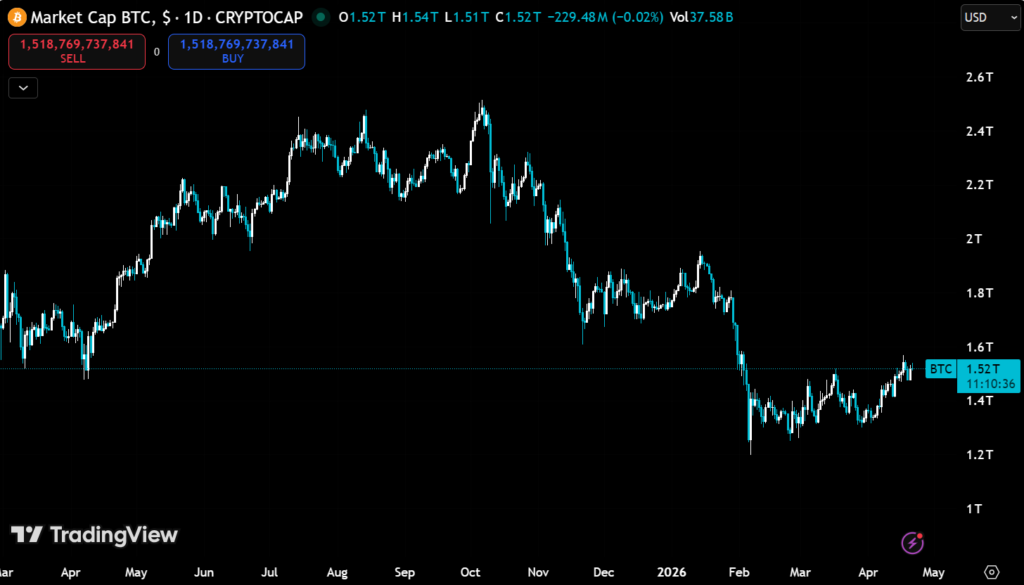
With the price of bitcoin at $76,456 and a market cap of $1.52 trillion, the price appears to be holding for now. What is more pertinent development is going to be the tension between the two flows: the alleged 32k BTC sold by miners in just the last quarter alone is a lot of selling, offsetting the inflows seen with the spot ETFs, and for the moment, absorption is strong. The question that comes here will be, “Will that continue?” We may see whether this holding of balance depends on whether this institutional demand becomes stationary or a rotational force.
Bitcoin Core release candidate v31.0rc4 contains a rewritten cluster mempool, I2P and Tor-only broadcasts, and updated fee estimation. These are all not just minor changes. Any miners and nodes running previous versions of the configuration need to be tested against this release candidate before it is released, especially as changes to mempool behavior have an effect on both transaction propagation and fee calculation.
Jai Bifulco, Chief Commercial Officer and Founding Member of Kinesis Money, stated:
Rate cuts are supportive, but they are not the real story. Confidence in fiat purchasing power is eroding, and capital is repricing where it seeks safety and credibility. Gold and bitcoin are both attracting that flow, but they are not interchangeable. Gold is behaving as an established monetary reserve asset. Bitcoin is still more closely tied to liquidity and risk sentiment. ETF inflows have added institutional depth, but it remains more macro-sensitive than gold. What connects them is that both are now being taken seriously as alternatives to conventional monetary risk. That is a meaningful shift. Where it goes from here depends on whether institutions treat that as a trade or a structural allocation.
Where Bifulco’s framing cuts through the noise. The supporters frequently overstate the BTC-as-gold thesis, while the opposition individuals often underestimate it. The view that needs to be taken into consideration is that we now have BTC and gold vying for the same ‘where should I stick my dollars?’ spot within institutions; both are successfully arguing for themselves but on different premises. Gold through the weight of institutional memory and reserve status, and Bitcoin on the ETF shell, which took away one of the main practical blockers to institutional allocation. Flows confirm the interest but not necessarily the endurance of the allocation.
XRP’s Cross-Chain Expansion and What It Actually Changes
The launch of wrapped XRP on Solana, through LayerZero, is structurally the newest information from this week’s data. It taps XRPL liquidity into Solana’s DeFi economy via a custodial bridge. For XRP holders, it allows access to yield and composability that doesn’t exist on the XRPL’s native layer. In the short term this is a net positive for the XRP price; more utility access is a more organic demand driver than pure speculation.
Nonetheless, the dimension of custody has some importance and should not be neglected. Custodial bridges have a history that needs to be assessed. As long as the structure of the bridge and of custody has not been subject to an audit and the results made available publicly, wXRP introduces a counterparty risk that has no equivalence for native XRPL transactions. The work Ripple has done on the RLUSD stablecoin and treasury integration for enterprises are parallel, but it is the bridge that has a new risk topology for users.
Solana’s Flat Week Masks Real Infrastructure Work
It becomes a must to not ignore the past 7-day trend of the layer 1 ecosystem, Solana (+0.01%), as a lack of movement. Currently, we are on a path toward Alpenglow (the rewrite for H1 2026 architecture) and the client releases over the past week have specifically been focusing on solving the failures from congestion that cause unstable states during periods of extreme demand. The technology was never the issue, but instead it was the execution at scale. If Alpenglow delivers at its performance goals, then a flat week on price will be negligible. If it fails at those performance goals, then the current price reflects reasonable doubt.


