




Foresight Ventures in its report, accessed exclusively by Times Crypto, confirms what many experts and analysts have feared. After studying six months of activity in the artificial intelligence payments sector the crypto research agency concluded that while most of the infrastructure for agentic commerce is now in place, actual adoption is still limited. Between September 2025 and March 2026, major payment players moved in parallel. OpenAI and Stripe launched the Agentic Commerce Protocol. Google also shared its Universal Commerce Protocol with more than 30 partners. Visa and Mastercard rolled out payment frameworks designed for agents. At the same time, Coinbase’s x402 processed over 15 million transactions on Base, while Stripe and Tempo developed the Machine Payments Protocol, which has now been submitted to the IETF.
Two Layers, Two Timelines
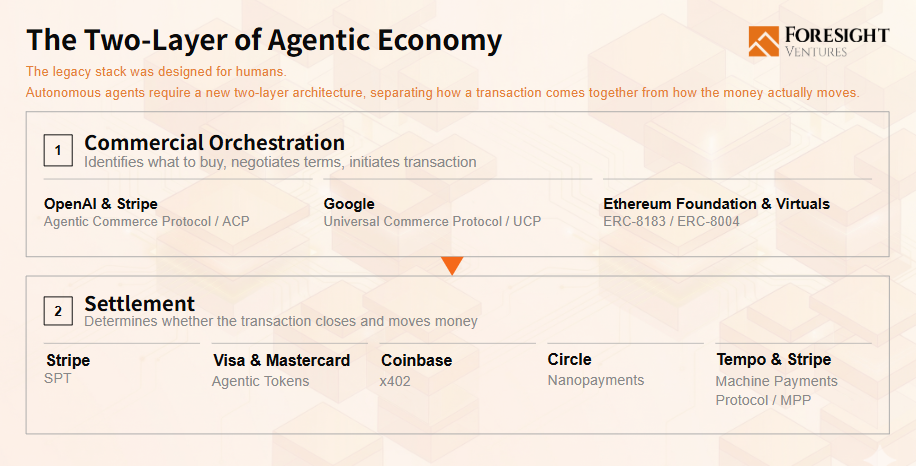
The Foresight Ventures report, authored by Bryan Vong, lays out the landscape based on a two-layer architecture that is already determining how competitive dynamics could unfold.
The first layer is commercial orchestration: how an agent identifies where to transact and initiates a purchase. The second is settlement: how money actually moves once the transaction is underway. These two layers are evolving on separate tracks, driven by different players with different incentives.
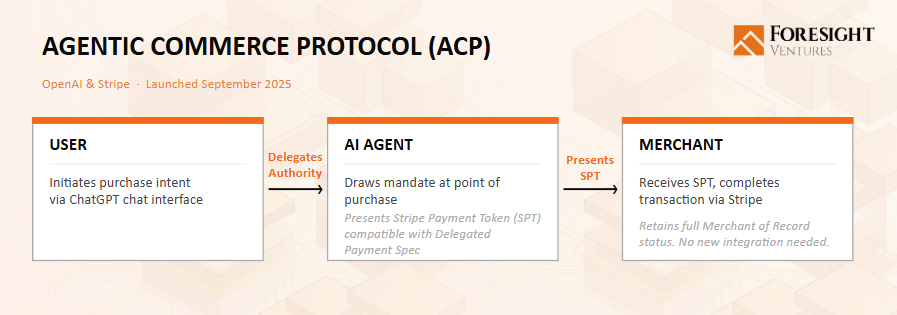
At the orchestration layer, the report identifies two structurally distinct categories of commerce. The first is agents acting on behalf of human consumers, a use case dominated by OpenAI’s ACP and Google’s UCP. The second is agents transacting autonomously with other agents, a category that currently has no card-rail equivalent and may ultimately require stablecoin settlement as its default.
ACP and UCP are not competing for the same position, and the distinction matters. ACP is a controlled environment by design: OpenAI decides which merchants participate, curates the experience end-to-end, and keeps the entire transaction within ChatGPT. That bet was tested and lost quickly. ChatGPT Instant Checkout launched in September 2025 and was quietly shut down in March 2026 after purchase conversion rates came in near zero. OpenAI has since pulled back to a more familiar role, surfacing products inside ChatGPT and handing users off to merchant sites to complete the actual purchase. ACP continues in a narrower form, powering dedicated in-app experiences for a small number of large retailers, but the vision of ChatGPT as a full checkout destination did not survive its first real market test.
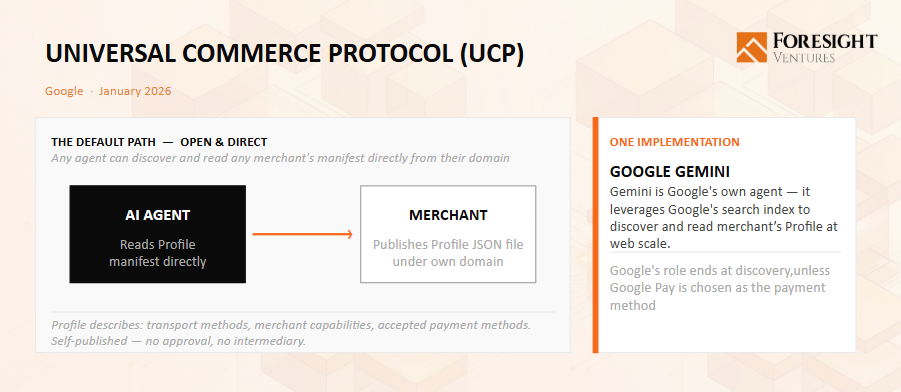
UCP operates on an opposite logic. Merchants publish structured JSON capability documents at a standardized domain path, allowing any compatible agent to read them without intermediaries, while Google manages discovery without controlling the transaction. The protocol is explicitly designed for interoperability with Google’s own Agent Payments Protocol; the Agent2Agent standard and the Model Context Protocol are deliberate positioning of Gemini as the primary discovery layer for agent-driven commerce, fully leveraging Google’s established search infrastructure.
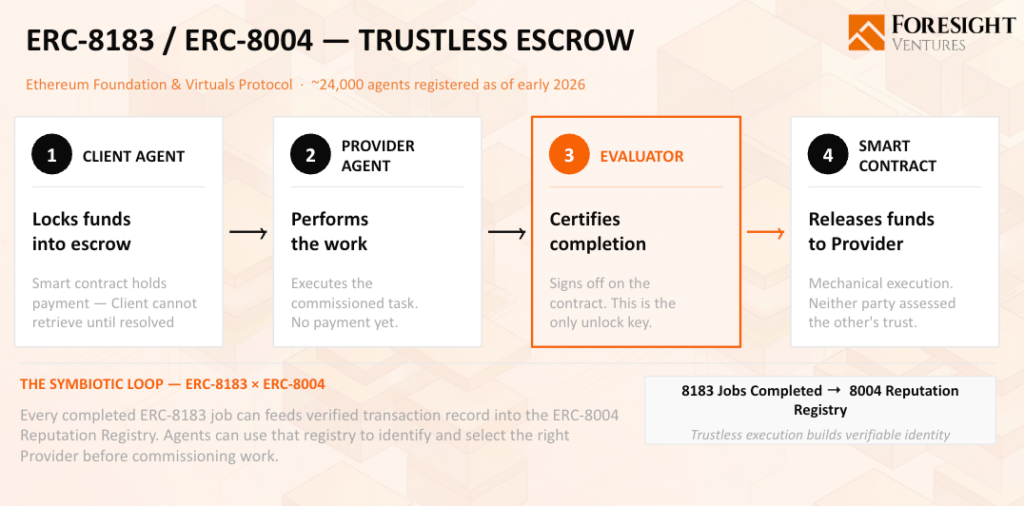
For agent-to-agent transactions, the trust problem is more fundamental. When no human is in the loop, the familiar anchors of terms of service, consumer protections, and chargeback rights simply do not apply. ERC-8183 and ERC-8004, proposed in March 2026 by the Ethereum Foundation’s dAI team alongside Virtuals Protocol, are designed to fill that gap. Instead of having two independent systems check if they can trust each other, ERC-8183 organizes each transaction with a neutral third party: a Client hires someone to do a job, a Provider does the job, and an Evaluator confirms it’s done before a smart contract pays. ERC-8004 sits underneath as the identity layer, building persistent on-chain reputation scores from transaction history so that credibility accumulates over time.
Five Settlement Protocols
The settlement layer is where the real competition is playing out, and the five protocols in contention differ in ways that actually matter to builders.
Stripe’s Shared Payment Token extends the card infrastructure most merchants already run on. It issues time-limited, merchant-scoped tokens that settle through existing Visa and Mastercard rails, carrying the consumer protections that come with card networks. The limitation is structural: card fees set a floor that makes high-frequency, sub-cent transactions economically unworkable. Visa and Mastercard have both upgraded their tokenization systems to accommodate agent-driven commerce, replacing static card numbers with dynamic encrypted tokens that carry agent identity, spend limits, and permitted merchants.
x402, developed by Coinbase, takes a different route entirely. It builds on the HTTP 402 status code, a payment trigger that has existed in the web’s specification since 1997 but was never widely used. An agent requests a resource, receives a 402 with payment parameters, signs an authorization, and settles in stablecoins on-chain within roughly two seconds. No accounts, no API keys, no KYC. The reported transaction volumes are large; real commerce volume is considerably smaller. Circle’s Nanopayments runs on a compatible architecture but adds batched settlement, absorbing gas costs at deposit rather than per transaction and making payments as small as $0.000001 viable. The catch is that both parties need pre-funded accounts, which keeps it semi-closed for now.
The Machine Payments Protocol, co-authored by Stripe and Tempo, is the most flexible of the five. Rather than committing to a single rail, it lets agents select at runtime between stablecoin settlement, card tokens, and Bitcoin Lightning payments, all within a unified HTTP 402-based framework. A developer does not have to choose at build time. The agent chooses at the moment of transaction.
Where the Actual Opportunity Sits
The infrastructure is mostly in place, but real deployment hasn’t started yet. The orchestration layer is already fragmented, with merchants forced to juggle multiple standards, SDKs, and compliance flows.
That fragmentation is structural. Every major platform has an incentive to keep agent traffic inside its ecosystem, not route it outward, something already visible in closed-loop strategies across ByteDance, Alibaba, and Southeast Asian super-apps. Settlement is likely to move the other way. As platforms multiply, pressure builds toward fewer, more universal payment rails and simpler integration for developers.
This creates a clear need for multi-rail wallets that can handle both card payments for traditional commerce and stablecoins for on-chain and agent-to-agent transactions. Neither rail is going away soon, so abstraction across both becomes essential for any general-purpose agent.
Beyond payments, the more open opportunity sits in agent-to-agent services. Agents can already technically pay for tasks like data, content, or code execution, but very few services are designed for that model. Identity and trust systems like ERC-8004 also need scale to work properly, which creates a cold-start problem. With agent adoption still early, despite long-term projections of billions by 2028, the timing gap is still wide.


