





ETH is down 3.18% to $2,313, and BTC has experienced a minimal gain of 0.87% to $77,410. That equals a 2.31 percent difference, and it is not noise; instead, it is an indication. It pointed out the targeted trend of retail profit taking that flowed through the centralized exchange, Binance. rather than macro pressures or large exchange-wide selloffs
It becomes important to understand why, looking past price and into the behavioral data that price does not immediately reveal.
The ETH/BTC Divergence
The ratio of ETH/BTC decreased by 1.51% and now sits at 0.02991. With the ratio and RSI of 39.43 for ETH/BTC in a daily time frame, the relative trend remains decidedly bearish. When a cross-asset ratio’s RSI dips below 40 it’s not an indication of transient short-term weak structure; it indicates significant and persistent structurally weak performance. There are no buyers for the ETH side of that trade.
One would typically assume a major macro risk-off hit Ethereum harder than Bitcoin, as it has done throughout previous cycles. However, the exchange flow data instantly contradicts that narrative.
Exchange Netflows Don’t Support a Macro Dump
The Ethereum: Exchange Netflow (Total) shows a value of -11,067 ETH for outflows across all the registered exchanges, well below the 7-day moving average value of -64,415 ETH.
This final point is something worth taking notice of. The outflow at only 17% of the SMA-7 (their recent average) signifies that there’s no generic wave of sell deposits throughout the general exchange ecosystem and it’s not dumping across the entire ecosystem. The total net flow is in fact more quiet than it has been in the last week.
Thus, the true paradox is that the on-chain exchange volume is somewhat flat but the price has massively underperformed the largest market-cap coin, lying in the proxy SOPR data.
Proxy SOPR Isolates the Actual Source of Pressure
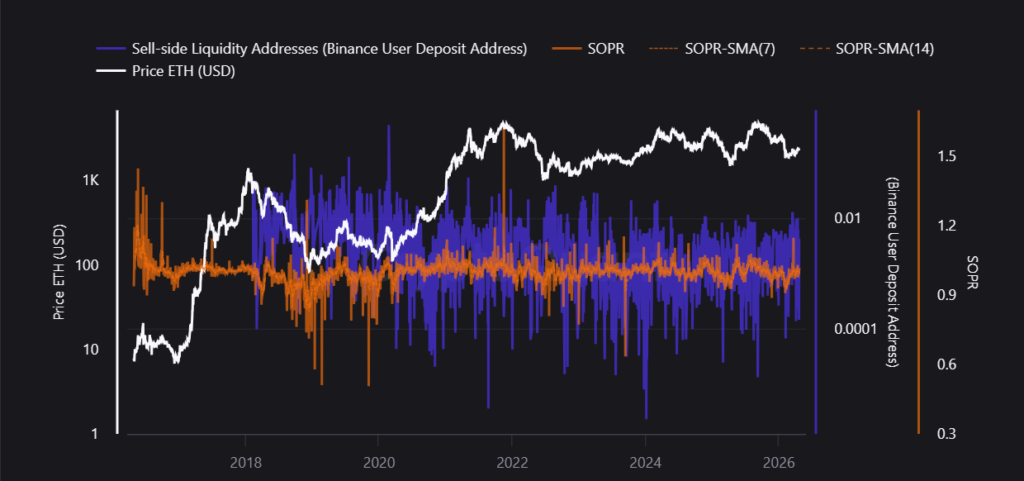
The Proxy SOPR framework works on making differentiations between various exchange flows; that’s why Proxy SOPR works as a proxy. Binance user deposit addresses act as a direct proxy for retail-induced sell-side liquidity. A sharp spike in this metric shows an increase of retail users moving coins to the exchange in one single move, which is to sell them. The size of the current spike, which is steep and vertical, indicates that this is not a normal spike when compared to the constant prior range.
SOPR Above 1: Confirming Profitable Exits
The global SOPR reading at 1.0069 effectively closes the analytical loop. Readings over 1.0 for SOPR simply state that coins are, in aggregate, moving at a profit in relation to their entry prices. Both the 7-day SMA (0.9973) and the 14 day SMA (1.0018) were holding readings under the current value, and this has since flipped.
What this confirms is that the sellers are not underwater. They are not panicking about liquidating at a loss but instead of that, they are deliberate. These are holders who accumulated at lower prices and are now using the current price range near $2,313 as an exit point for rational profit realization, not forced selling.
This distinction is critically important in the understanding of what occurs after. A panic-driven selloff exhausts rapidly and typically sparks violent bounces. This retail, profit-motivated selling on Binance is a distinctive phenomenon. It could continue across many sessions as cohorts are exiting in waves, capping the market rather than flushing it.
The Sell-Side Is Structurally In Control, For Now
The three data layers show the same direction, i.e. The ETH/BTC RSI value at 39.43 indicates relative weakness still exists and the Proxy SOPR spike to 0.00435658 indicates that the active deposits from Binance retail are still in action. The global SOPR value of 1.0069, which exceeds the two critical moving averages, indicates that these deposits are yielding profits upon exit.
The low has been marked for the aggregate exchange net flow (-11,067 ETH vs. -64,415 SMA-7), which actually reinforces rather than contradicts this picture. The current flows could be elevated among the centralized exchanges in the case of broad selling and panic. Instead, the pressure is channeled. Retail has found its exit ramp in Binance and is using it while profits still exist.
For Ethereum to recover relative ground against Bitcoin, this specific cohort needs to exhaust its supply. That requires either the price falling enough to deter sellers (erasing the profit margin) or the deposit surge dissipating naturally as motivated sellers complete their exits. Until one of those conditions materializes, the immediate overhead remains heavy. The ETH/BTC ratio at 0.02991 and an RSI of 39.43 suggest the market has not yet found that floor.
What You Need to Take Care of
Traders watching the ETH/BTC cross should treat 0.02991 as a live resistance-from-below level; a reclaim of that level with volume would be the first credible sign that sell-side pressure is clearing. Until then, any ETH price recovery attempt into this zone is likely to face renewed friction from the same retail deposit cohort identified by the Proxy SOPR.
Considering the perspective of the spot holders, the SOPR data suggests the current weakness is not a macro capitulation event. Holdings are not at systemic risk. But the overhead created by retail profit-taking is real and quantifiable. Patience, not urgency, is the appropriate posture while this cohort works through its exits.


