
Solana is in an uncanny stage where on-chain performance and price action are going in opposite directions. The network is still moving large amounts of value across its ecosystem, on one hand. On the other hand, its token price remains stuck in a tight range, struggling to break higher with conviction.
This gap between usage and valuation has become the central debate around Solana’s current market structure.
Record Network Activity, But Slowing Momentum in Key Metrics
The most striking figure coming out of Solana’s ecosystem is the estimated $1.1 trillion in economic activity processed during Q1 2026. This level of throughput places Solana among the most heavily used blockchains in the industry by raw activity.
However, the strength of that headline number contrasts sharply with several underlying indicators that have begun to weaken. Total transactions have dropped by roughly 10% to around 2.3 billion, while active addresses declined about 30% to around 5.4 million, according to Glassnode. Subscription fees have also decreased by around 22%, with the firm now paying roughly $15.9 million in that regard.
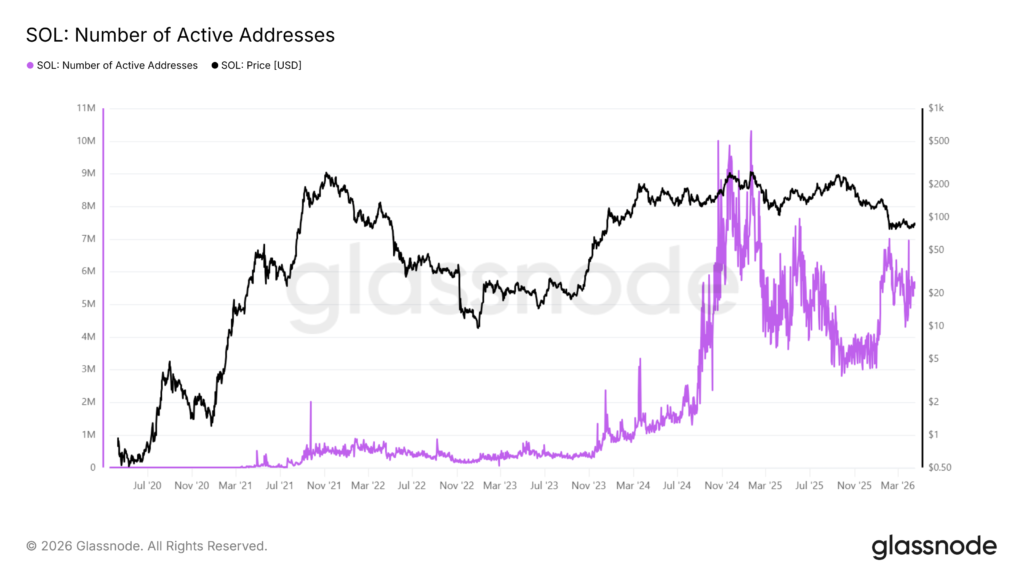
Such deviation implies that Solana continues to process large amounts of value, but participation across the network is not growing at previous levels. The stablecoin supply of the ecosystem has increased to approximately $16B, indicating liquidity remains in the market; however, user activity patterns are less consistent than in previous growth cycles.
At the same time, competition within high-speed trading and decentralized exchange infrastructure has intensified. Platforms such as Hyperliquid have begun capturing segments of trading activity that previously flowed more heavily through Solana-based applications. This shift has added pressure to Solana’s dominance narrative, even as total value throughput remains high.
Price Struggles to Break Resistance Despite Short-Term Strength
Solana’s price is sitting around $87.66 right now, having gone up about 3% in the last 24 hours. It also climbed 5.7% over the past week and nearly 9.9% in the last 14 days, which shows it’s starting to gain a little momentum in the short term.
Even with these recent jumps, the bigger picture still seems pretty fragile. If you look at the last month, SOL is still down roughly 6.8%, and over the past year, it’s dropped about 34.3%. This long-term weakness really highlights how far it remains from its previous peak prices.
Right now, the price is moving within a pretty narrow range. In the last day, it’s been trading between $84.27 and $90.10. This area seems to have turned into a bit of a struggle zone, with several tries to break higher not really sticking.
From a technical standpoint, Solana is still below important moving averages. These are lines that often show where the price might go in the mid-term. The price seems to hit a wall between roughly $87 and $90, where it has stopped going up many times, even after some quick gains.
ETF Flows, Alameda Activity, and Supply Pressure Shape Sentiment
Beyond on-chain activity and price charts, capital flows have become a decisive factor in Solana’s current positioning. Solana exchange-traded funds have recorded a pretty inconsistent pattern in their inflows. While a lot of money is currently flowing into the ETFs, that money hasn’t been coming in steadily enough to really push things in one clear direction.
Meanwhile, regular investors have also jumped in more when prices have tried to break higher lately. This makes the market a bit jumpy for a short time, but it hasn’t led to a steady increase yet. Because of all this, the market tends to react fast to any shift in how things are moving, but it really has trouble sticking to a path.
Adding another layer of complexity, wallet movements tied to Alameda Research and the FTX estate have introduced ongoing supply considerations. Around 198,000 SOL, valued at approximately $16 million, was recently moved as part of creditor-related distributions. While this process is structured and gradual rather than sudden, it still represents a steady stream of potential supply entering the market over time. Larger remaining holdings linked to the estate continue to keep this factor in focus for traders.