





At the time of writing, Bitcoin is trading at $70,870 on Monday, absorbing a broader risk-off shock that caused oil futures to surge 9.3% above $105 per barrel and sharply lower U.S. equity futures after President Donald Trump announced a U.S. Navy blockade of the Strait of Hormuz over the weekend. The price action is, by narrow technical definition, remaining resilient. The largest cryptocurrency is down just 0.93% in 24 hours. But the macro backdrop against which that resilience is being measured has deteriorated sharply, and the structural underpinnings of the current range deserve careful examination.
The Macro Transmission Channel Is Wide Open
The single most important data point for understanding Bitcoin’s near-term risk is its 7-day correlation to U.S. equity ETFs: 0.93 to SPY, 0.95 to QQQ, 0.93 to IWM, and 0.90 to DIA. These are not loose relationships and they are near-lockstep correlations, meaning that any sustained selloff in U.S. equities carries a high probability of transmitting directly into crypto prices. With Dow futures down 0.79%, S&P 500 futures down 0.76%, and Nasdaq futures down 0.85% on Monday morning, the equity signal is unambiguously negative.
The Hormuz blockade adds a specific inflationary transmission mechanism. WTI crude above $105 per barrel raises input costs broadly, pressures real economic growth expectations, and simultaneously squeezes central bank flexibility. That combination of rising energy costs alongside slowing growth risk is historically among the most corrosive environments for high-beta risk assets, of which Bitcoin remains a canonical example at current sentiment levels.
Asia’s equity markets confirmed the risk-off tone. The KOSPI fell nearly 1% to 5,805. Japan’s Nikkei dropped 0.94% to below 56,500, with the yen depreciating past 159.5 per dollar for a third consecutive session. India’s SENSEX declined 1.76% to 76,007, directly impacted by its oil import exposure, with the rupee sliding to 93.37 per dollar. Hong Kong’s Hang Seng fell 1.15% to 25,600. Even gold dropped approximately 2% to below $4,700 an ounce, suggesting that part of Monday’s move involves liquidity-driven position reduction rather than straightforward risk rotation.
Trump’s warning that countries aiding Iran’s military, explicitly including China, could face tariffs of up to 50% adds a secondary risk layer. The scenario where Gulf escalation intersects with existing U.S.-China trade tensions introduces supply chain and tariff dynamics that markets have not yet begun to price fully. China’s Shanghai Composite fell a modest 0.17% to 3,980 on Monday, but the offshore yuan weakening to approximately 6.83 per dollar suggests pressure building beneath a relatively calm surface.
Where Bitcoin Actually Stands
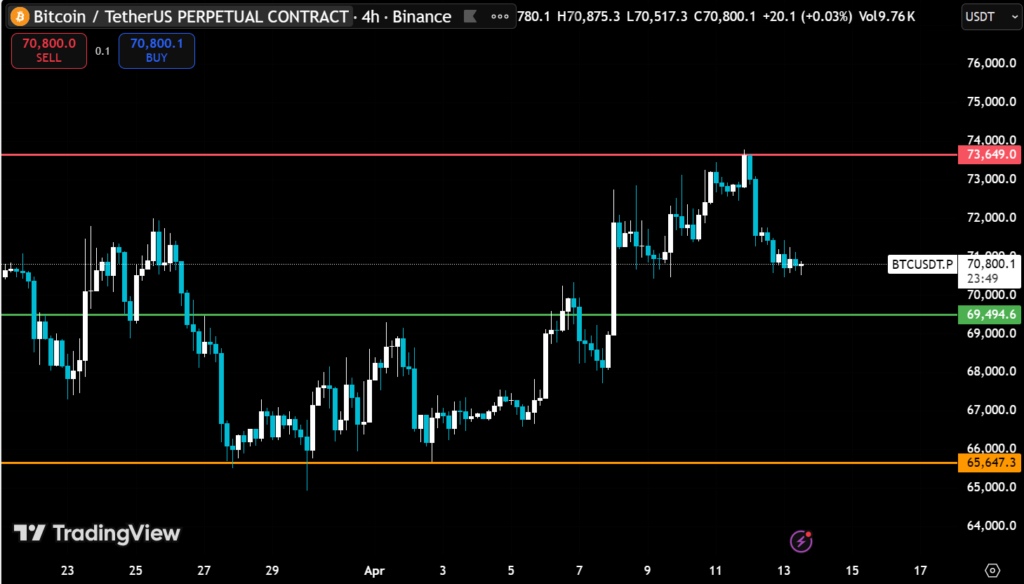
Bitcoin’s 7-day price action traced a $68,859 low on April 7 to a $73,056 high on April 12, a narrow $4,197 operating range that produced a weekly gain of just +1.79% and a 30-day gain of 0.26%, numbers that describe sideways consolidation rather than a trending market. The current price of $70,870 sits 43.84% below the all-time high of $126,198, and the 90-day return of -23.04% alongside a 1-year return of -16.05% confirms that near-term stability is being built within a larger structural drawdown, not above it. That context is directly relevant to how the market responds under macro stress, given that the marginal buyers sustaining this range are institutional, and institutional capital manages drawdown exposure against defined risk thresholds in ways that long-term retail accumulators typically do not, meaning a sustained macro deterioration does not simply pause buying activity but can actively accelerate selling.
The Derivatives Stack: Scale and Sensitivity
Total global crypto derivatives open interest currently stands at $456.47 billion, with perpetual futures accounting for $453.65 billion of that figure. Open interest has risen 7.08% in 24 hours and 11.02% over 7 days, meaning leverage is being added into a macro uncertainty event rather than reduced ahead of it. The spot-to-perpetuals volume ratio of approximately 0.26 reinforces the concern: for every dollar of spot volume, roughly four dollars of perpetual volume are changing hands. During a macro shock, that structure means any directional move can cascade quickly through stop-outs and forced liquidations. The 30-day liquidation total of $3.04 billion confirms significant forced selling has already occurred in the current period. The 24-hour liquidation of $35.99 million, down 61% from the prior day, suggests a temporary stabilization but not a full clearing of the overhang.
Funding rates at approximately +0.00018581% are near zero and the market is not in an aggressively leveraged-long condition, which is a relative positive. But rising open interest alongside even marginally positive funding, into a deteriorating macro backdrop, means the market is incrementally building long exposure at exactly the wrong moment.
The Institutional Floor and What It Actually Represents
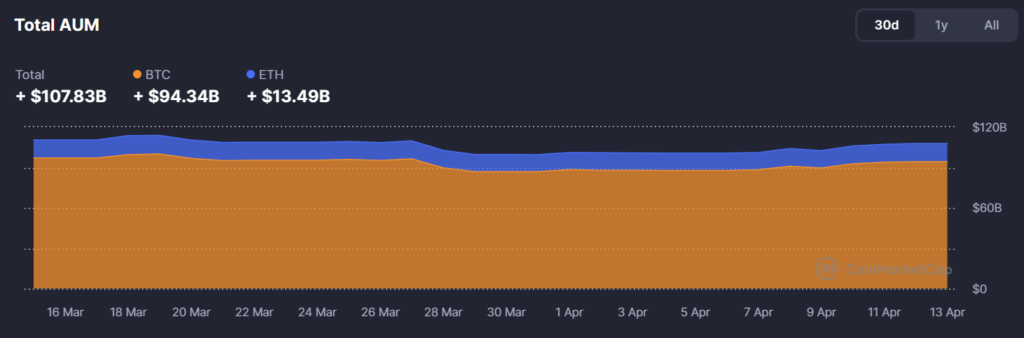
The structural feature that distinguishes Bitcoin’s current market from prior cycles is the $94.34 billion in U.S. spot ETF AUM, which represents a large, persistent institutional demand pool whose holders entered through regulated vehicles and behave materially differently from leveraged retail speculators.
Vikrant Sharma, Founder of CakeWallet, captured the dynamic precisely: “The ETF inflows vs. on-chain distribution is actually a healthy sign of market maturation. Institutions pouring in $471 million in a single day and pushing past $56 billion cumulatively means bitcoin is getting a whole new class of long-term holders. Self-custody wallets selling off is just natural profit-taking. But the fact that it’s not leading to price collapse is a very bullish sign. The Bitcoin space is bigger and wider now, and the floor under the price continues to be more stable and less volatile.”
The pattern of on-chain distribution without price collapse is analytically significant and it suggests ETF inflows are absorbing supply as long-term holders take profits, creating a structural floor more durable than order-book-level support. Sustained ETF outflows triggered by equity market stress, particularly if institutional risk managers begin treating BTC as a high-beta equity substitute during a drawdown, would remove the most important demand-side anchor the market currently holds.


