Three straight months of volume records. The gold order book is 7.2x deeper than the platform median. Two crude oil contracts that in sixty days secured a 15.3% share of the global market. These results by MEXC in Q1 2026 TradFi Futures were not a case of good luck at all. They were a case of standard placement.
The Volume Numbers and What Drove Them
The 138% month-over-month spike in volume in February would normally catch one’s attention. The significant data point, however, was what followed. Another 45% came in April on top of that inflated base. It’s sustained acceleration (instead of a spike and retreat) that is indicative of structural demand growth.
And it’s relevant to the macro story here, too. Geopolitical instability rose precipitously in the Middle East in late February and this simultaneously made energy and precious metals fluctuate. 3rd march experienced the highest volume day of the quarter across the MEXC TradFi and this one was dramatic enough to liquidate less solid venues; MEXC scooped these up.
This boosted monthly active traders by 58% cumulatively on the quarter. Available TradFi instruments grew 62% QoQ and now include precious metals, energy, U.S. equities, global indices, forex, and ETFs. Growing instrument count at that rate suggests that MEXC isn’t just riding existing product volume but increasing the available market for their liquidity infrastructure.
| Metric | Q1 2026 |
|---|---|
| February MoM Volume Growth | +138% |
| March MoM Volume Growth | +45% |
| Cumulative MAT Growth | +58% |
| Instrument Lineup Expansion QoQ | +62% |
Gold and Silver Dominate the TradFi Futures
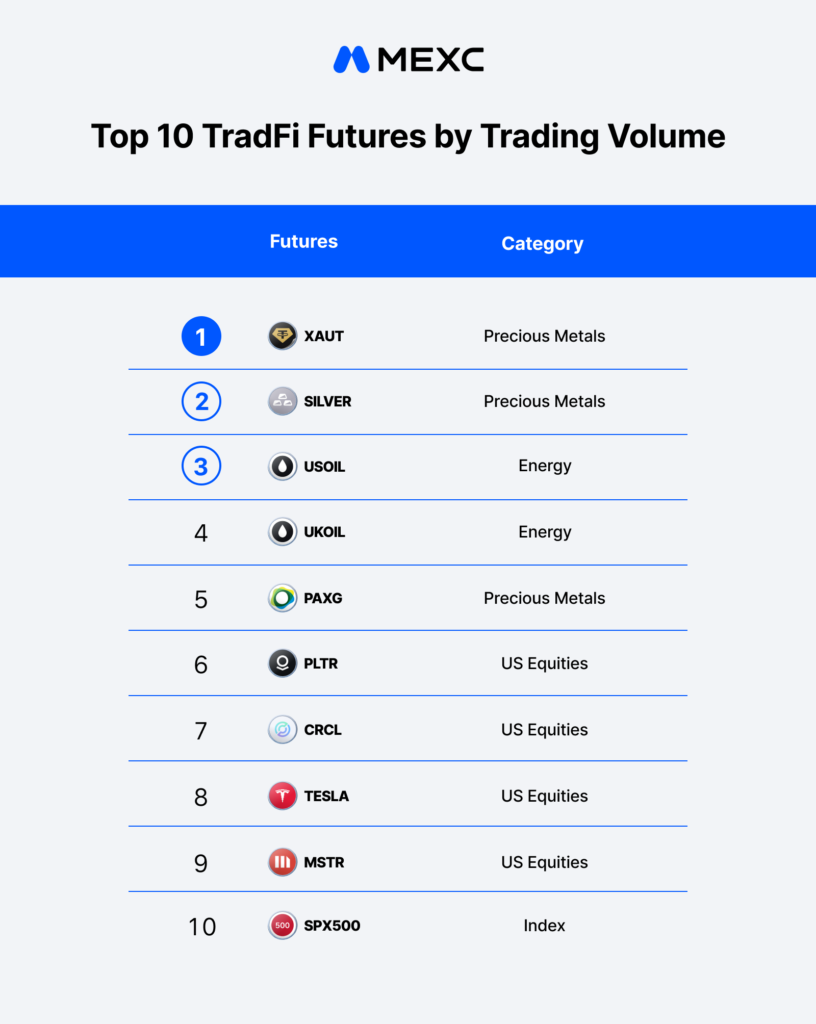
WIth the 71% and 22%, respectively, XAUT and SILVER both participated heavily in the top-10 combined trading volume. Combined they represent more than 90%. PAXG sat at fifth place, proving that user action remained tied to precious metals. For the quarter, this was the correct position to be. Safe-haven demands, dollar weakness, and the political instability in the Middle East all combined to produce a perfect scenario for high-frequency precious metals trading.
Still, the concentration is noteworthy. On a platform where 90% of the top-10 volume is precious metals, there is an amplification on the macro commodity cycle. The result is still favorable if macro commodity cycles are as positive as this quarter. Therefore, the energy categories reaching the top 4 are even more important than what they are currently implying in volume share. It also points out to us that the product mix is starting to broaden.
The Crude Oil Launch Was a Timing Call That Paid Off
MEXC listed USOIL (WTI) and UKOIL (Brent) perpetual futures on January 30. In less than two months, both contracts went up into the top 4 volume positions and collectively owned 15.3% of the global Q1 volume, making MEXC 3rd globally. It was no coincidence that they list so close to the critical geopolitical turning point, allowing order books to be active when volatile periods hit, instead of launching into empty pools.
Even the competitive landscape for crude oil is incredibly unique. Nearly all of the major platforms have almost zero volume in their crude derivatives. Very few are allowing both WTI and Brent Perps, like MEXC. Which in itself means that 15.3% of the market was secured from a marketplace where almost all of their competition had pretty much vacated, in what seems like an even lower-resistance route to a top-three spot than in the gold or silver markets.
Order Book Depth: The Number That Explains Everything Else
Volume rankings and market share figures describe outcomes. Order book depth explains why those outcomes happened.
In the gold futures market tested on March 23, 2026, MEXC’s order book at the top five price levels ranked first among seven major platforms, including Binance, Bybit, OKX, Bitget, Hyperliquid, and BingX. The depth at those levels was 7.2 times the median of competing platforms.
On 100,000 USDT, the standardized market order slippage was 43% below the industry median for gold. Silver slippage was 66% below. USOIL slippage was 25% below. UKOIL slippage was over 54% lower. For the $10,000 retail trader, it’s a small amount, but it adds up. For the $500,000+ institutional trader, the cumulative savings per session will be significant enough to be a differentiator.
| Asset | Slippage vs. Industry Median (100K USDT Order) |
|---|---|
| Gold (XAUT) | 43% lower |
| Silver | 66% lower |
| USOIL (WTI) | 25% lower |
| UKOIL (Brent) | 54%+ lower |
In addition to its execution and pricing benefits, the depth advantage also contributes to system stability. When books are shallow, they become significantly more volatile, leading to an exponential increase in slippage during fast markets and thus a need for predictability when it is least reliable. Q1 has provided a real-world stress test during gold and oil’s volatile sessions.
Market Share: The Competitive Scoreboard
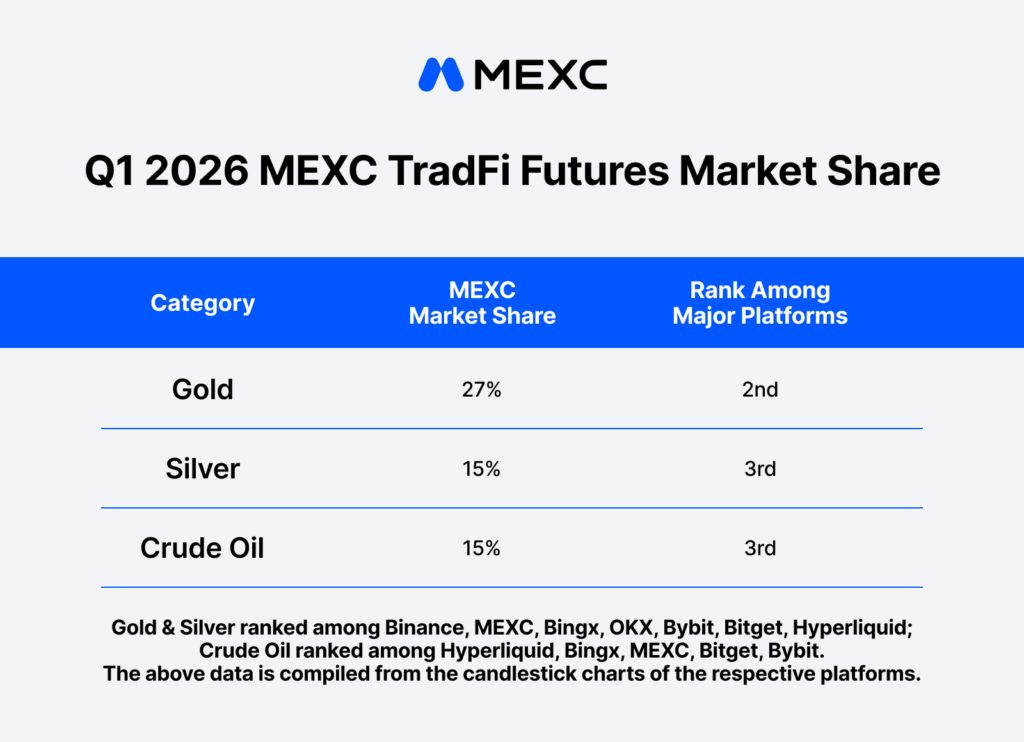
Gold futures-MEXC ranked 2nd globally for gold futures with a market share of 27.4% for Q1 and in Feb, month-over-month market share reached 30.3%, narrowing the gap from the 1st platform by 4%. For Silver, it captured 14.6% on a global scale and reached more than 6 percentage points month-over-month growth for March, showing the quickest pace among comparable platforms.
These numbers gain some more significance when viewed in combination with the order book data. Market share at these levels is not a marketing tale but rather a clear sign of where large order flow is going and large order flow is going where depth is. There is a direct correlation between MEXC’s dominance in depth and its market share performance throughout Q1.
What Q2 Looks Like From Here
Vugar Usi Zade, CEO of MEXC stated:
Gold and oil volatility created a window of opportunity and lucrative entry points for those who are prepared. We positioned ourselves ahead of the curve with the right instruments, deep liquidity ready to execute large orders, and a frictionless fee model that empowers decisive action.
The structural depth on two of the largest categories, the early stage crude oil market share gain, and the 58% user increase over 3 months position MEXC in Q2 well-positioned with the ability to play macro rotations, not just precious metals.
For Q2, the real question becomes whether they can maintain this heightened volume level without a similar macro volatility catalyst. Both Feb and March were bolstered by favorable Gold/Oil environments. The lower macro volatility environment will test whether the depth, no-fee, and variety of instruments are enough to hold on to the new traders who came during volatility. Q1 numbers built the “seat,” and Q2 will show if that seat has growth.