





Solana (SOL) is trading at $85.70, sitting inside the yellow consolidation zone that has defined price action for the better part of April’s first two weeks. That zone, approximately $85–$87 maps directly onto the 61.8% Fibonacci retracement at $84.69 and the 50.0% level at $87.12, making it one of the most technically significant ranges on the entire SOL chart since the February swing highs near $120.
The broader context is that of sustained compression following a sharp 40.76% decline over the past 90 days. Price fell from a local top near the $115–$120 resistance band clearly marked on the 4-hour chart below as the large red supply zone all the way to the $75–$76 grey support zone visible near the chart’s lower boundary. What has unfolded since that bottom is a gradual recovery, with SOL reclaiming the $80 level and now pressing against the yellow zone for the third distinct test in April.
What the Yellow Zone Actually Represents
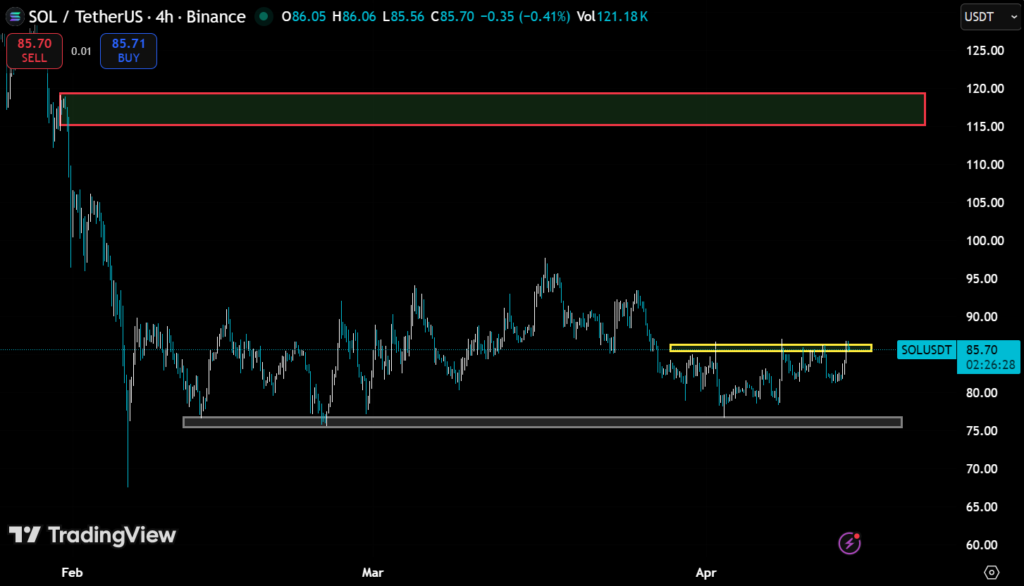
The yellow box on the 4-hour chart sits between roughly $85 and $86.50, and its significance is structural rather than arbitrary. Multiple prior sessions used this range as a ceiling, with price repeatedly tagging it, failing to close decisively above, and retracing toward the $79–$80 area. That rejection pattern gives the zone the character of a supply cluster, with residual selling pressure from traders who entered during the early April recovery and are looking to exit near breakeven.
The Fibonacci overlay reinforces this read. The 61.8% retracement of the swing from $76.82 to $97.42 sits at $84.69, while the 50.0% level lands at $87.12. SOL is currently sandwiched between these two levels. Closing and holding above $87.12 on the 4-hour timeframe would represent a confirmed 50% retracement hold, which historically carries forward bias. Failing to do so keeps the 61.8% level in play as support, with the $81.23 (78.6% retracement) as the next meaningful floor below.
Volume Confirms the Setup Has Real Stakes
The 24-hour volume of $5.5 billion, up 64.51% from the prior day, is not something to overlook. Volume expansions of this magnitude typically precede directional resolution rather than continued consolidation. When price sits in a defined supply zone and volume surges, the outcome of that test becomes higher conviction in either direction: sustained buying absorbs the supply and produces a breakout, or the supply overwhelms demand and forces a rejection toward the $79–$80 area or lower.
That $5.5 billion in 24-hour volume, against a market cap of $49.3 billion, represents a volume- to-market-cap ratio of approximately 11.2%, a figure that signals genuine participation rather than thin, noise-driven price movement. Traders should treat the current zone test as one that has institutional-grade interest behind it, making the resolution more likely to be decisive and less likely to simply fade back into low-volume drift.
Momentum Indicators: Leaning Bullish, Not Confirmed
The daily technical indicators support a cautious bullish read without overconfirming it. The MACD histogram is printing at +0.54097, with the MACD line at -0.72592 having crossed above the signal line at -1.27 a configuration that signals momentum is accelerating to the upside even though the MACD lines themselves remain in negative territory. This is precisely the kind of early-cycle setup that precedes a more significant move if the price structure cooperates.
RSI for the respective time frame sits at 53.70 and confirms mid-range momentum without the overbought conditions that would invite mean-reversion selling. The 7-day RSI at 60.23 reflects the strength of the recent recovery from lows but also suggests there is room to run before reaching the 70-plus levels that historically mark exhaustion. Daily pivot sits at $84.95, and a price above that level maintains the mild bullish session bias.
The short-term moving averages indicate that SOL trades above both its SMA7 ($84.21) and EMA7 ($83.99), a configuration that confirms the recent trend direction. The SMA30 at $85.69 is essentially the current price, meaning the market is at the mean on the intermediate timeframe, precisely the kind of inflection point where direction gets decided.
The Levels That Matter Most
Immediate resistance: The yellow zone ceiling near $86.50 is the first obstacle, followed by the Fibonacci 38.2% retracement at $89.55 and the psychologically significant $90.00 level. A decisive 4-hour close above $89.55 would represent the clearest bullish signal for the asset, as it would shift price from inside the Fibonacci retracement cluster into territory where the 23.6% level at $92.56 and then the swing high at $97.42 become the primary targets.
Immediate support: The 61.8% Fibonacci level at $84.69 and the daily pivot at $84.95 form a narrow but meaningful support cluster. A breakdown below $84.69 on elevated volume would open a retest of the $81.23 range (78.6% Fibonacci) and, if that fails, the grey support zone visible on the chart near $75–$76, which absorbed the prior major selloff.
The red resistance box on the 4-hour chart, spanning roughly $115–$120, remains 35% or more above the current price. The SMA200 at $130.04 and EMA200 at $117.39 sit well overhead, confirming that on any timeframe longer than a few weeks, SOL remains in a structurally bearish trend. Any bullish case in the current setup is a range trade or a short-term momentum play, not a thesis that the longer-term trend has reversed.
Trading Perspective: What to Expect?
A confirmed 4-hour close above $87.50 with sustained volume would shift the technical narrative from a series of failed attempts into a legitimate breakout, opening the path toward the 38.2% Fibonacci level at $89.55 and eventually the 23.6% level at $92.56. Conversely, continued rejection from this zone without a clean close above it only deepens the resistance credibility, reinforcing the case that the supply cluster formed during the February-to-March decline remains intact and unabsorbed. The yellow zone does not need a trade attached to it to be meaningful. Its resolution will define how SOL is read in every higher timeframe in the weeks ahead.
For those who respect the broader trend, the approach is different: the 30-day and 90-day returns of -3.04% and -40.76%, respectively, are not the profile of an asset in a healthy recovery; they are the profile of a structurally weak asset exhibiting counter-trend bounces. The yellow zone has rejected the asset’s price multiple times already. A fourth touch without a breakout only reinforces the ceiling’s strength, and a failure here that drives the price back below $80 would confirm that the path of least resistance remains to the downside.
Forward Perspective
The next 24–48 hours of price action in the yellow zone will set up one of the cleaner risk/reward setups on the SOL chart in recent weeks. The volume is showing a decent strength, the momentum indicators are turning constructive, and the Fibonacci levels have drawn a clear line between a bullish resolution and a bearish one. What the chart has not yet provided is a confirmed breakout, and until that confirmation appears, the weight of the evidence from the 90-day trend and the long-term moving averages argues for treating this zone as resistance first and opportunity second.


