





AAVE price jumped 8% after Aave DAO approved a major funding package for Aave Labs, pushing the token toward $100 resistance. The move arrived as buyers defended the $90-$95 zone and forced a sharp reversal on the daily chart.
At the same time, the governance decision signaled a broader shift inside the Aave ecosystem. The new framework gives Aave Labs fresh resources, ties long-term incentives to growth, and directs more product-driven value back to the DAO. Consequently, traders now watch whether the AAVE price can clear $100 and extend the rebound.
Aave DAO Backs a New Growth Structure
Aave entered a new chapter after its DAO approved the proposal known as Aave Will Win. The measure gained close to 75% support from voters. As a result, Aave Labs will receive $25 million in stablecoins and 75,000 AAVE tokens.
The stablecoin allocation will support operating costs over the next 12 months. Meanwhile, the token grant will vest over four years. That structure links the team’s incentives to the protocol’s longer-term expansion. Moreover, it reduces the chance of a short-term focus.
The proposal does more than fund development. It changes how the ecosystem organizes itself. Aave Labs will now operate as a DAO-funded entity rather than a privately rewarded builder. Hence, revenue from products built under this framework should return to the DAO treasury.
That change matters because it gives the community a more direct stake in ecosystem growth. It also creates a clearer connection between execution and shared value. Additionally, the plan prepares the ground for Aave V4, which stands as the next major technical step for the protocol.
The framework also includes plans for a new entity to oversee the brand. That addition points to a more mature structure across product, governance, and market strategy. Besides, it reflects how DeFi projects now compete on trust, coordination, and long-term positioning.
Why the Proposal Matters Beyond Funding
The funding package arrived at an important time for Aave. The protocol already ranks among the largest names in decentralized finance. Its total value locked exceeds $25 billion, which shows its strong presence across on-chain lending.
Still, size alone does not guarantee future growth. DeFi now faces rising competition, faster product cycles, and growing interest from institutions and fintech firms. Consequently, projects need sharper execution and stronger internal alignment.
This framework addresses those needs directly. It gives Aave Labs the resources to move faster. It also creates a system where ecosystem gains flow back to the DAO. Moreover, it supports the idea that governance should guide strategy rather than react to events.
The proposal also reveals a wider trend across crypto. Major protocols no longer rely only on token incentives and community enthusiasm. They need operating structures that can support products, legal coordination, brand direction, and technical upgrades. Significantly, Aave now appears willing to formalize those pieces under one strategy.
That approach could help Aave compete for the next wave of on-chain activity. More traditional financial firms now explore blockchain-based credit, collateral, and liquidity systems. Additionally, users want smoother and more useful financial tools. Aave’s latest move suggests the DAO wants to build for both demands.
Governance Debate Exposes Lingering Tensions
Even so, the proposal did not pass without resistance. Some community members questioned the size of the package. Others raised concerns about governance implications tied to voting-power-bearing tokens. Moreover, some participants wanted clearer definitions around protocol revenue.
Those concerns speak to a broader issue inside decentralized governance. Communities often want both speed and strict decentralization. However, those goals can conflict when a protocol reaches scale. Large ecosystems need strong execution, yet they also need credible checks on power.
In Aave’s case, the debate already created friction. Key governance contributors stepped away, and decentralization standards became a point of dispute. Consequently, the funding approval may strengthen product development while also testing community cohesion.
That tension will likely remain part of the story going forward. The DAO now has to prove that the new structure can deliver results without weakening governance credibility. Moreover, the openness of treasury flows, product revenue, and strategic choices will be more important than ever.
Nevertheless, the market reaction is that the first consideration was growth potential by traders. The approval generated a more powerful story on expansion, implementation, and subsequent product releases. Therefore, the AAVE price responded promptly when the sentiment recovered.
AAVE Price Rebounds From Demand Zone
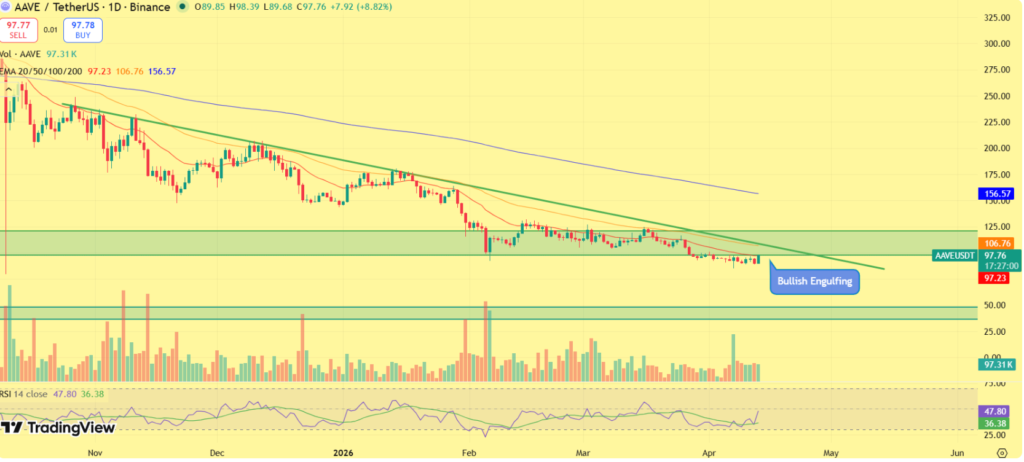
The price action turned sharply after AAVE held the $90-$95 area. That zone had already acted as a demand region during the recent decline. Once sellers failed to break it decisively, buyers stepped in with stronger conviction.
AAVE price then printed a bullish engulfing candle on the daily chart. That pattern marked a clear rejection of lower levels. It also disrupted the sequence of lower highs that had defined the prior downtrend. Consequently, the chart now shows the first signs of an early recovery phase.
The rebound pushed AAVE price back toward the $96 mark and then closer to nearby resistance. Moreover, the move developed with stronger participation rather than weak spot buying alone. That detail gives the bounce more relevance.
The first technical barrier now sits near the 20-day moving average around $97-$98. A sustained move above that level would reinforce the shift in short-term momentum. However, the market still treats $100 as the real test.
Source: TradingView
That level carries both technical and psychological weight. It lines up with prior breakdown structure and likely holds a concentration of short positions. Consequently, a clean break above $100 could open the door to a faster move higher.
Derivatives Data Adds Support to the Move
The recent rebound also gained support from derivatives activity. Volume rose 14.65% over 24 hours to $293.94 million. At the same time, open interest climbed 8.04% to $231.15 million.

Source: Coinglass
That combination often signals fresh positioning entering the market alongside price strength. In other words, traders did not treat the move as a brief relief bounce. Instead, participation expanded as the AAVE price recovered from support.
Positioning still shows a slight tilt toward the short side. Net longs stand near 295.78K, while net shorts remain around 345.10K. However, the more important signal comes from the slowdown in aggressive short buildup.
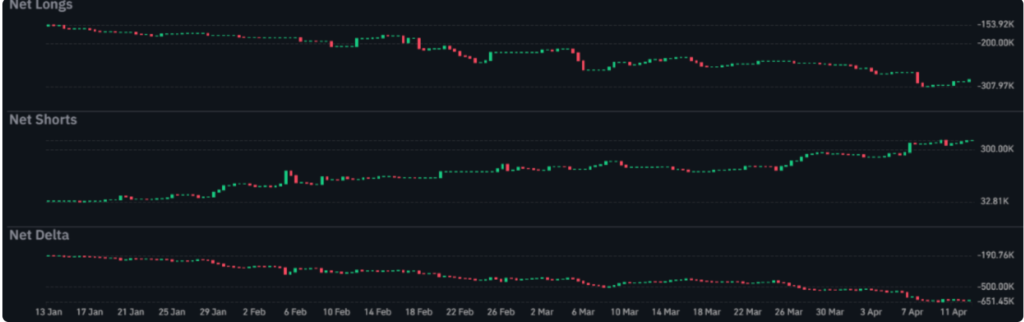
After a prolonged decline in net delta, the reading has started to stabilize. That shift suggests sellers are losing control at the margin. Moreover, it creates a setup where upside pressure can grow quickly if resistance breaks.
When shorts remain elevated but stop increasing, markets often become more sensitive to positive moves. Hence, the $100 level now matters even more. A push above that area could force covering activity and add momentum to the breakout.
Final Take
AAVE price sits in a transition zone. The broader downtrend has not fully disappeared, but its structure has started to weaken. Buyers reclaimed control near support, and the rebound carries stronger volume and open interest.
The next step depends on follow-through. AAVE price needs to hold above the immediate recovery zone and break through the resistance band near $97-$100. If that happens, the next upside area could emerge near $110-$115. That range includes the 50-day moving average and prior supply.


