





Ethereum is trading at $2,185.44, sitting approximately 8.4% below a resistance level that has already rejected price once this month. That single data point captures the central tension in ETH’s current market structure: the worst of the February breakdown appears to be behind it, but the path back toward meaningful recovery territory remains technically blocked.
The Breakdown That Defined the Current Setup
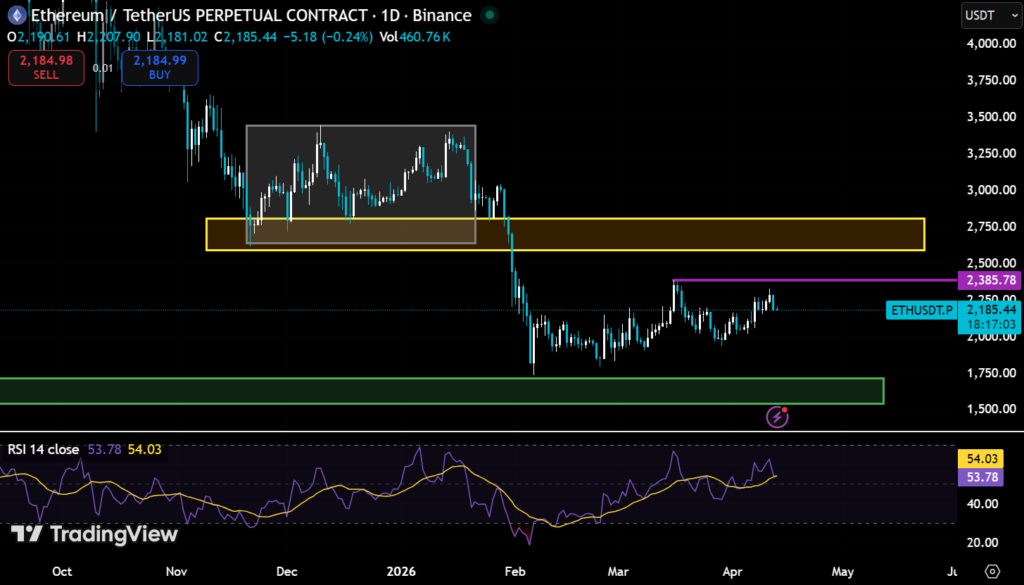
To understand where Ethereum is now, the February price action is the reference point that cannot be skipped. The chart shows ETH spent roughly three months from late October through late January consolidating within a wide range bounded by approximately $2,750 on the lower end and $3,400 at the upper boundary. That consolidation zone, marked by the grey box on the daily chart, represented a prolonged period of indecision following the decline from higher levels.
When the $2,750 support zone broke, the selloff was not a gradual one. Price dropped sharply from that level all the way to a low near $1,750, a decline of approximately 36% from the breakdown point. The yellow/brown demand zone on the chart spanning roughly $2,700 to $2,800 had previously acted as a floor for months. Once it failed to hold, it converted to a ceiling, which is precisely the kind of structural role reversal that shapes technical setups for weeks afterward.
That breakdown low near $1,750 aligns with the green demand zone visible at the bottom of the chart, which appears to mark a longer-term support zone. Price bounced from that region, and the current recovery has now retraced approximately $435 from the low, bringing ETH back to $2,185 at time of writing.
What the Recovery Has Actually Achieved
The multi-timeframe performance data for the asset shows the recovery’s scope and its limits. The current 7-day return of +2.65% and 30-day return of +4.66% confirm that buying pressure has been steady, not a single-day spike. The 60-day figure of +11.41% indicates that the move off the $1,750 low has been a sustained grind higher throughout multiple weeks.
However, the 90-day return of -30.18% immediately reframes those gains. Zooming out to a three-month window, ETH has lost nearly a third of its value. The 60-day recovery has not come close to the recovery from the February collapse, and the -55.86% drawdown from the all-time high of $4,953.73 highlights how far away Ethereum is still from peak valuation.
According to data from CoinMarketCap, the 24-hour volume of $12.54 billion and a market cap of $263.89 billion indicate that Ethereum maintains considerable liquidity and market presence. But volume alone does not validate directional momentum, and the current chart structure implies conviction on the buy side remains limited.
The $2,385 Resistance Problem
The most important level on the chart right now is $2,385.78, marked by the purple horizontal line. This is not an arbitrary level and it corresponds to a high that was established during the March recovery attempt before the price pulled back to its current range. The fact that the market has already tested and rejected this level makes it a confirmed resistance zone rather than a theoretical one.
ETH now holds it value at $2,185 and holds approximately $200 lower than resistance, representing a gap of roughly 9.1%. For context, closing that gap would demand a move of similar momentum and volume to the entire 30-day return. The structure here suggests that while the recovery trend is intact, its most significant near-term obstacle sits very close overhead relative to the overall trend since the February low.
The green support zone near $1,500 to $1,750 provides a broader safety net on the downside, but the relevant battleground for the coming weeks is the $200 corridor between the current price and the $2,385 ceiling.
Momentum That Supports but Does Not Confirm
The RSI indicator shows two lines: the yellow signal line reading 54.03 and the purple RSI reading at 53.78. Both values sit just above the 50 midpoint, which places momentum in marginally positive territory without indicating any overbought condition.
This RSI positioning is consistent with the broader recovery narrative the market is not in oversold distress, nor is it showing the kind of momentum that typically precedes sharp directional moves. The RSI was deeply oversold during the February selloff, reaching levels near 20 on the chart, and the current reading at 53-54 represents a meaningful recovery in momentum terms. Critically, the two lines are tightly compressed and running nearly parallel, which reflects a lack of strong directional acceleration in either direction.
A push toward $2,385 would likely require the RSI to build toward the 60-65 range. A rejection from resistance that drags RSI back below 50 would be an early technical signal that the recovery has run out of steam.
Setup for the Traders
The setup resolves into two scenarios that are relatively clean to monitor. The first is a breakout above $2,385 with decent volume, suggesting that the recovery has enough momentum to reclaim the former support zone around $2,750 as a longer-term target. That would require a 26% move from current levels and a complete recapture of the key breakdown zone.
The second scenario is continued consolidation or a rejection from the $2,385 level, which keeps ETH range-bound between approximately $1,900 and $2,385 for an extended period. Given the 90-day performance data and the scale of the prior breakdown, this scenario is the more structurally conservative expectation.
The 1-year return of +35.70% provides some longer-term perspective on Ethereum’s positioning. This digital asset remains in positive territory on an annual basis despite the significant mid-cycle decline.


