




Table of Contents
Sullivan & Cromwell disclosed that an emergency motion it filed in the Prince Global Holdings bankruptcy case contained inaccurate citations, AI hallucinations and other errors, leading the firm to apologize to the court and submit a corrected version of the filing.
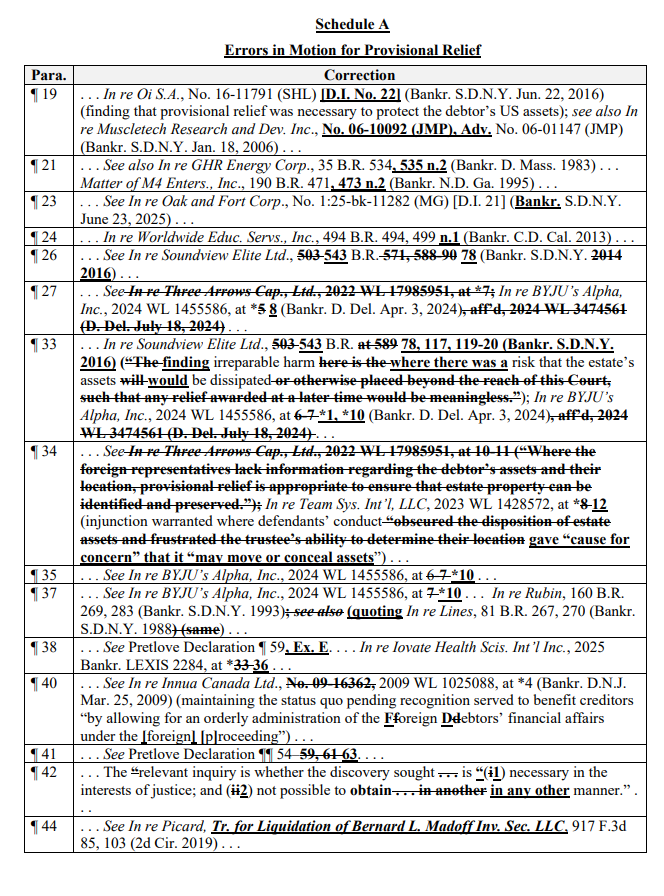
According to an April 18, 2026 letter filed in the U.S. Bankruptcy Court for the Southern District of New York, the law firm said it became aware that the joint provisional liquidators’ emergency motion, filed on April 9, included flawed citations and additional mistakes identified in an attached Schedule A.
The firm said the inaccuracies included AI hallucinations, which it described as instances where artificial intelligence tools fabricate case citations, misquote legal authorities or generate sources that do not exist.
Internal Controls Broke Down
Sullivan & Cromwell said it deeply regretted the lapse, adding that its internal safeguards were designed to prevent exactly that kind of problem. However, those safeguards were not followed in preparing the motion, the firm noted.
Sullivan & Cromwell also said its broader citation-review process failed to detect the inaccurate material generated by AI, as well as other mistakes that appeared to stem in whole or in part from manual error.
In the letter, partner Andrew G. Dietderich took responsibility for the failure to ensure the accuracy of the court submission, adding that the firm maintains clear and rigorous rules for the use of AI in legal work, including mandatory training that lawyers must complete before they are granted access to generative AI tools.
The filing said that training repeatedly warns lawyers about the risk of hallucinations, including fabricated citations, faulty interpretations and inaccurate quotations. It also instructs them to independently verify all AI-generated output and says failure to do so violates firm policy.
Schedule A Reveals Range of Errors
The attached schedule shows the problems extended beyond a few isolated miscites. On pages 3 through 5, the filing lists corrections to paragraph references, case names, docket numbers, pincites, quotations and statutory references across the provisional-relief motion and several related filings. The corrections also cover the verified petition, the motion for joint administration, the motion scheduling the recognition hearing, and declarations filed in the case.
Nature of the Errors
The mistakes were not mainly grammatical or severe enough to render the text unreadable, but instead reflected a mix of AI hallucinations, structural citation flaws and clerical errors, including inaccurate or invented legal authorities, misquoted cases, broken quotations, faulty pinpoint citations, confusion between legal provisions, and incorrect dates, paragraph numbers and similar filing defects.
Sullivan & Cromwell said it had re-reviewed all filings in the matter and found no other AI-related errors, although it did identify some non-substantive and clerical mistakes elsewhere in the case papers. The firm said it was undertaking remedial measures, including a full review of how the errors occurred and whether further enhancements to its internal training and review systems are needed. It also said a corrected version of the motion and a redline were being filed the same day.


