





The five largest digital assets by market capitalization all registered gains over the past seven days, with Bitcoin crossing above $74,500, Ethereum reaching $2,375.63, and even the weak performers of the group posting single-digit weekly advances. On the first look, the situation looks like a broad-based recovery. The 90-day time period matters far more than just the weekend candles.
The Short-Term Signal Everyone Is Watching
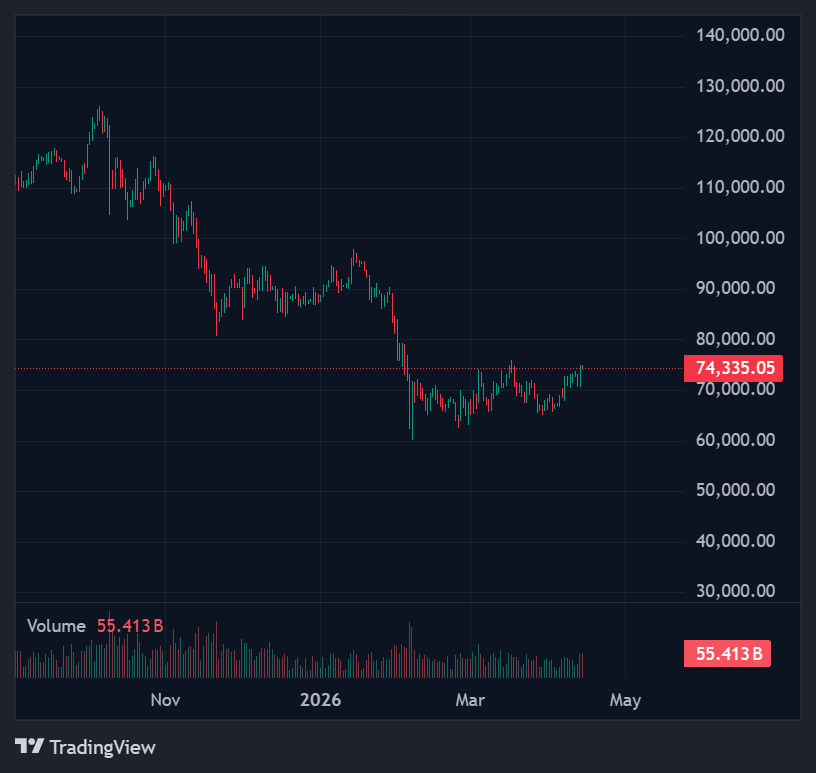
Bitcoin’s 24-hour move of +5.06% and its seven-day gain of +9.00% are drawing attention, as they typically do when BTC clears a psychologically significant level. Ethereum’s performance is actually more aggressive on the shorter timeframes, posting +8.70% in 24 hours and +13.85% over seven days, the strongest weekly figure in the group. Solana came in with +8.75% on the week, while XRP and BNB lagged at +5.06% and +3.31% respectively.
These numbers reflect a market that is, at minimum, finding buyers at current levels. Combined 24-hour trading volume across the five assets totaled roughly $94.69 billion, with Bitcoin accounting for $55.19 billion of that figure and Ethereum contributing $28.87 billion. The volume profile confirms this is not a low-liquidity move engineered by thin order books.
Where the Structure Actually Breaks Down
The 30-day column is where the asset group begins to fragment. Bitcoin is the only asset in positive territory over the past month at +3.72%, a modest but meaningful distinction. Ethereum, the second largest cryptocurrency by market cap, has recovered sharply over 30 days at +12.10%, which partially explains why its short-term momentum is leading the group. XRP, BNB, and Solana remain negative over the same window at -3.09%, -6.88%, and -2.68%, respectively, meaning the current weekly bounce has not yet recovered from the damage from the prior month.
The 90-day figures are the most instructive data in the entire set. Solana has declined 40.26% over the quarter, the steepest drop among the five digital assets. XRP follows at -35.40%, BNB at -33.66%, and Ethereum at -27.87%. Bitcoin’s 90-day loss of -21.50%, while significant in absolute terms, represents the shallowest drawdown in the group by a considerable margin. This is the relative strength that needs to be considered when the market has sold off broadly. Considering the price performance, Bitcoin has lost less ground when compared with the other major assets.
What the Structural Divergence Actually Means
The pattern emerging from these numbers is one of risk tiering under stress. Bitcoin, which now carries a $1.49 trillion market cap and a circulating supply of 20.02 million against a hard cap of 21 million, continues to absorb drawdowns more efficiently than assets with less constrained supply dynamics. The 90-day gap between Bitcoin at -21.50% and Solana at -40.26% represents a nearly 19-percentage-point difference in loss magnitude and this can’t be considered as noise.
BNB’s position is structurally distinct from the others in one specific way. The asset operates with a fully circulating supply of 136.36 million tokens against a maximum of 136.36 million, and Binance’s Auto-Burn mechanism continues to reduce the theoretical ceiling toward 100 million. Despite this supply compression, BNB’s 90-day performance at -33.66% suggests the burn mechanism alone is insufficient to insulate price action when broader market conditions deteriorate.
Ethereum’s 30-day gain of +12.10% is the strongest monthly figure in the group, but the denominator matters here. That recovery is being measured from a price level that was itself the product of a 27.87% quarterly collapse, which means the recent upside is closing a hole rather than opening new ground. An asset that falls 27% and then recovers 12% has not turned bullish. Following this event, it has evolved to be less deeply underwater. The $28.87 billion in 24-hour trading volume relative to a $286.72 billion market cap, with a turnover ratio of roughly 10%, implies that the move is backed by genuine interest from the market participants. However, volume only confirms that a trade is happening, not that it is correct.
The Market Data Points for Traders
For traders managing active positions, the immediate question is whether the weekly gains represent the beginning of a sustained recovery or a bounce within a larger corrective structure. The price data for the assets supports caution at that point. Four of the five assets remain negative over 30 days, and all five are significantly negative over 90 days. A five-day rally does not resolve a quarter-long drawdown.
For longer-horizon allocators, the 90-day relative performance data offers a more actionable signal. Bitcoin’s demonstrably lower drawdown magnitude during a period when the broader digital asset market was selling off sharply is consistent with its historical behavior as the defensive allocation within the space. Solana’s 40.26% quarterly loss, against a 24-hour volume of only $5.77 billion relative to its $49.46 billion market cap, points to continued liquidity fragility.
XRP’s position is the most ambiguous. The asset has not recovered its 30-day losses despite having a $84.29 billion market cap and validator infrastructure across approximately 150 nodes. The 24-hour volume of $2.86 billion, while not insignificant, is modest relative to XRP’s market cap and suggests the network’s fundamental activity is not generating price-sustaining demand at current levels.
Forward View
The narrow positive territory Bitcoin has maintained on the 30-day timeframe, combined with its comparatively contained 90-day loss, positions it as the current fulcrum asset in any meaningful recovery scenario. If the market is forming a base, Bitcoin’s behavior over the next two to three weeks will likely define the ceiling and pace for the broader group. If the 90-day drawdowns reassert themselves, assets with deeper quarterly losses, particularly Solana and XRP, have less technical cushion to absorb a second leg lower.
The weekly numbers are encouraging but the quarterly numbers demand that encouragement be held carefully.


