




A new academic study found that prediction market accuracy stems from a small group of informed traders, not from the broad “wisdom of the crowd.”
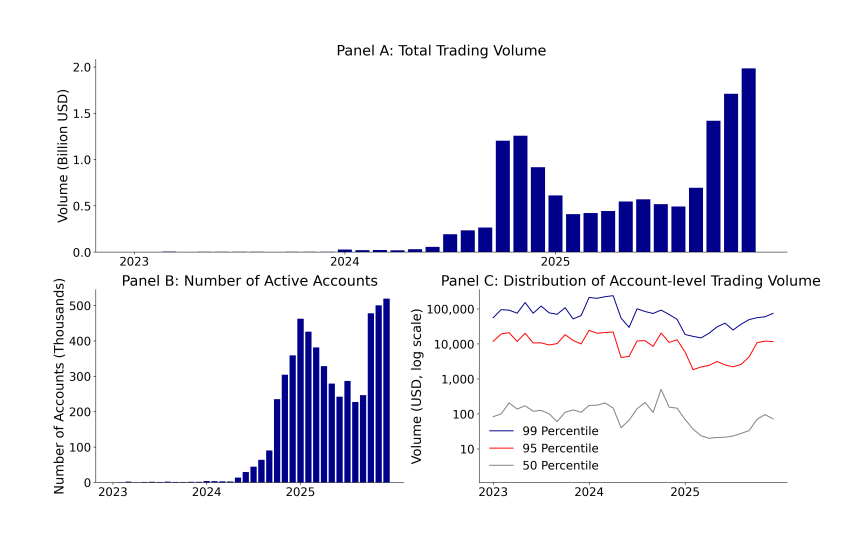
The paper, titled Prediction Market Accuracy: ‘Crowd Wisdom or Informed Minority?’ analyzed the full picture of Polymarket transactions across markets created after Jan. 1, 2023, and resolved by Dec. 31, 2025.
The dataset covered 98,906 events, 210,322 markets, $13.76 billion in trading volume, and 1.72 million accounts, offering a rare account-level look at how information moves through one of the world’s largest prediction market platforms.
“Prediction market accuracy thus reflects the wisdom of an informed minority, not the wisdom of the crowd,” the authors wrote.
A Few Traders Carry the Signal
The study, written by Roberto Gómez-Cram, Yunhan Guo, Theis Ingerslev Jensen, and Howard Kung, challenges the common view that prediction market prices become accurate by aggregating information from many participants. The researchers found instead that roughly 3% of Polymarket accounts classified as skilled traders generated much of the platform’s price discovery.
To distinguish skill from luck, the authors built a statistical test that kept each trader’s actual trades, including size, timing, and market choice, but randomized whether the trader bought or sold. That allowed them to compare real profits against a no-skill benchmark.
The test classified 3.14% of accounts as skilled winners, 28.95% as lucky winners, 61.40% as unlucky losers, and 6.41% as unskilled losers, while market makers accounted for just 0.10% of accounts.
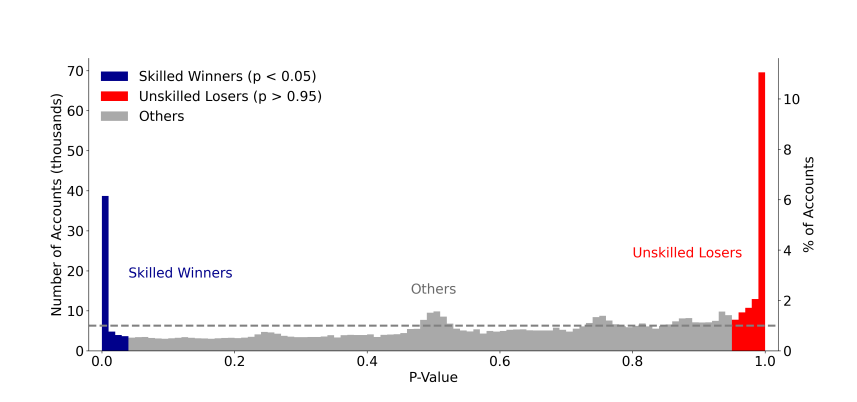
The authors said skilled traders’ order flow predicted both future price moves and final market outcomes, while lucky winners, despite positive profits, showed no meaningful predictive power.
Most Users Add Volume, Not Accuracy
The paper found that the majority of Polymarket users generated trading volume but contributed little to the accuracy of prices. Skilled traders, by contrast, made prices more accurate throughout a market’s lifespan, with their influence becoming stronger as events approached resolution.
The authors said the findings show that realized profit alone is a weak measure of ability. With more than 1.7 million accounts, some traders will inevitably make money by chance. In the study’s out-of-sample test, 44% of accounts classified as skilled in one sample remained skilled in another, while many lucky winners later lost money.
News Reaction Comes From the Informed Minority
The researchers also studied scheduled news events, including Federal Reserve policy announcements and corporate earnings releases, to see which traders reacted first when new information arrived. Skilled traders were the only group whose order flow consistently moved in the direction of the news surprise.
The paper also examined possible insider trading, citing prediction markets’ lighter oversight, pseudonymous accounts, and narrowly defined event contracts as risk factors. While suspicious accounts had large price effects when they traded, the authors found those trades were concentrated in relatively few events and did not explain overall price discovery.
Informed Traders Drive Market Accuracy
The study concludes that prediction markets are not simply crowd machines. Their accuracy comes from a smaller group of traders whose bets carry more information than the broader flow of market activity.
That does not make prediction markets less useful, but it changes how their signals should be read. A price may reflect the market, but the study suggests its forecasting value depends on whether informed traders are active enough to shape it.


