




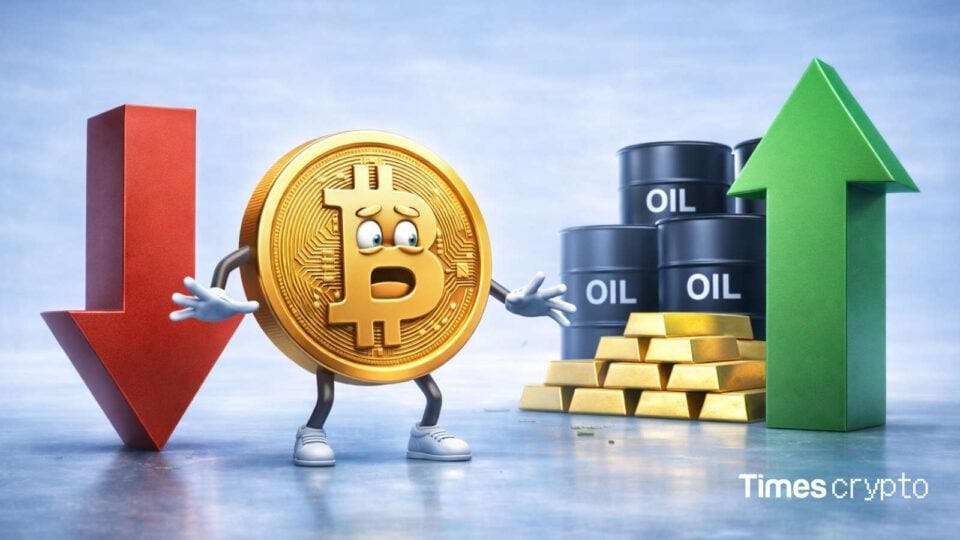
On Friday, April 24, 2026, markets traded more carefully as fresh tension in the Strait of Hormuz lifted oil, kept gold firm, and pressured stocks and crypto.
Crypto
Crypto markets are easing, with total capitalization at $2.59 trillion, down 1.55%, while the Fear & Greed Index at 58 points to a market that has turned more cautious than optimistic, the Altcoin Season reading at 35 shows money is still favoring Bitcoin over smaller tokens, and the RSI at 48.22 suggests the pullback remains measured.
Bitcoin trades at $77,837, down 0.47%, holding up better than the rest of the market, while Ethereum fell to $2,313.33, down 2.56%, Solana slipped to $85.32, down 1.78%, and BNB edged lower to $636.31, down 0.18%.
Spot Bitcoin ETF flows are still providing support in the background. On April 20, the group recorded $238 million in net inflows, followed by $12 million on April 21, before picking up again to $336 million on April 22.
Commodities
Oil remains the clearest expression of geopolitical risk. U.S. crude trades at $96.27, up 3.67%, and Brent stands at $106.09, also up 3.67%, as traders price in the risk of tighter supply and further disruption around one of the world’s most important shipping lanes.
Gold is at $4,700.50, down 0.92% on the day, a mild retreat that still leaves it near elevated levels as safe-haven demand remains firm amid conflict risk and rising energy prices.
Stock Market Indices
U.S. stocks are lower, with the S&P 500 at 7,111.08, down 0.38%, the Dow Jones Industrial Average at 49,330.74, down 0.32%, and the Nasdaq Composite at 24,436.33, down 0.90%. The selling is heaviest in technology, where investors are taking profits and reassessing valuations against a more difficult geopolitical backdrop.
Globally, the FTSE 100 fell 0.58% to 10,403.6, while Japan’s Nikkei 225 slipped 0.29% to 58,970, reflecting the same cautious tone across global markets.
Geopolitics & Market Sentiment
On the diplomatic front, investors are focused on the Middle East after Iran seized ships in the Strait of Hormuz and said talks would not resume unless the U.S. lifted its blockade, while Israel warned it could launch further attacks, leaving markets highly sensitive to any escalation.
On the economic front, the bigger concern for markets is that higher oil prices may add to inflation and make the rate outlook harder to read, leaving central banks cautious as investors reduce risk.


