





The Ethereum derivatives market is going through a significant deleveraging of the market, as across a wide range of exchanges, 30 day readings of open interest have fallen sharply into negative figures. Current values are now mirroring those in what can be said to have been one of the more significant derivative resets, that of April 2025.
The Gate.io Signal
The largest move of the current cycle is being made via Gate.io. On April 21 2026, Gate.io’s 30 day OI (open interest) change was roughly -461,000 ETH. This is one of the most negative prints that can be seen anywhere on the multi-exchange data recorded in the above chart going back to mid-2023. It is not the most negative print Gate.io has made on this statistic, but still it remains close.
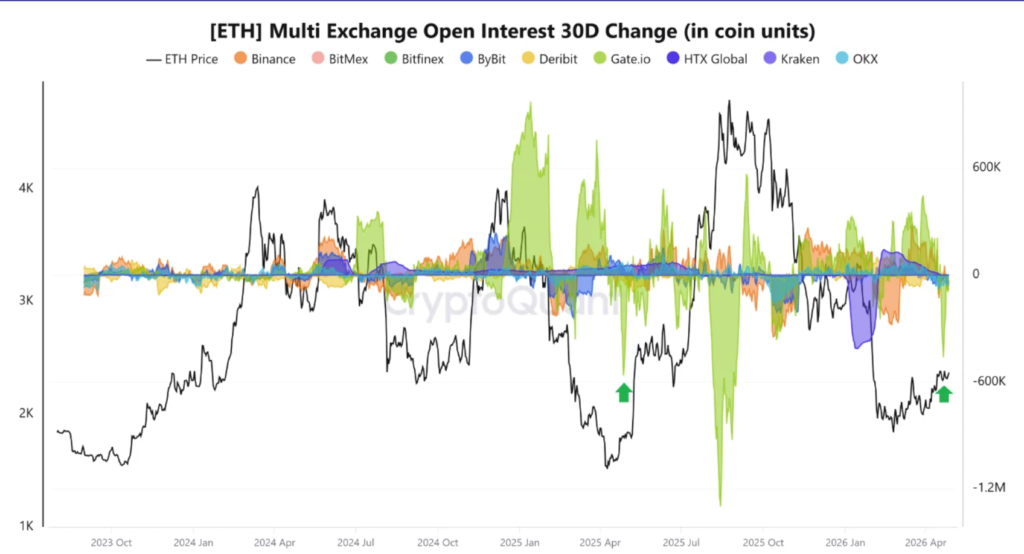
At the time of writing, the price experienced the deepest single reading, where Gate.io’s 30-day OI change experienced a drop to nearly 654,500 ETH. Considering the current situation, it is not the same but remains in the same range at 461,000 ETH. Taking into consideration the dataset, there is no exchange that has produced this kind of raw ETH denominated OI swing.
This was an important place to be positioning for ETH futures, especially for those making use of coin-margined contracts. A 30-day OI contraction of -461,000 ETH means the net amount of ETH put up for open futures positions decreased by this much during the period (closing, liquidating, or expiration). This structure had contracted meaningfully during that exchange.
Binance Backs Up the Trend
A reading for Gate.io alone would be noteworthy. The two exchanges, Gate.io and Binance, moving together in the same direction at the same time, represent a distinct category of signal. Binance today put up a reading of roughly 81,200 ETH change in OI for the last 30 days. Gate.io reports a higher absolute number, suggesting that the market participants should assign less weight to that reading. Binance, being the highest-volume perpetuals exchange globally, tends to have a somewhat smoother flow to OI moves, and a reading of -81,200 represents a respectable reduction as opposed to a serious wipeout.
The directional confirmation is the only thing that makes Binance’s data more important. The analysis doesn’t point out that Gate.io is contracting in a single state while Binance is experiencing holds steady side or expanding. At the same time, both of them are pointing to the negative side of the metric. The leverage flush can be considered the market-wide condition, as it shows up with cross-exchange alignment. It is a real market event, as it is not a Gate.io technical glitch and also Binance parameters in the same direction give it additional confirmation.
The other platforms, ByBit, OKX, Deribit, Kraken, HTX Global, BitMex, Bitfinex all seem relatively drained throughout the period. It’s easy to see the color breakdown in the chart showing that most of the negative OI signal is being pushed by Gate.io (light green) and balanced with some directional bias from Binance (orange). The fact that most of the signal is concentrated in these two centralized exchanges and not dispersed across the other listed platforms says a bit about where most of the speculative position was before the flush.
Why April 2025 Is the Relevant Comparison
The most relevant example from the past that one can find is the April 2025 show and while not the fact that price has done something subsequent is key, the mechanics and structure were the identical.
That time, Gate.io’s 30 day OI was -654,500 ETH which is the biggest figure in the above provided chart, at the same time, Ethereum’s price had already slumped from its recent high, and the derivatives positions were all squeezed up. As a result one can see, falling price and falling open interest in coin terms represent that the market is deleveraging rather than overleveraging, positions that were crowded being squeezed.
Following that flush positioning, Ethereum had a much cleaner market structure then and there was no immediate next directional move, and it’s not to say there will be now either. It’s that once the derivatives market has deleveraged like this, there is less ‘noise’ from the setup for the next large move either way. There are fewer forced sellers stuck in leveraged longs and fewer forced buyers pressed into leveraged shorts depending on where the outsize positioning had been.
The current situation is pointing out the same structural thing, which is a rapid contraction of the open interest, which is ETH denominated. This is concentrated on the three things that are taking place at the same time, like the futures positions that are experiencing fast closure; it is also being reflected on the exchanges where the speculation is happening on a major basis. There is still a huge gap between the current Ethereum spot price and its respective all-time high. This is showing up as the same condition with a relatively the same pattern.
What Open Interest in Coin Terms Actually Measures
The open interest in terms of coins reads the open position for the asset, which is ETH in this case. It doesn’t count the USD value, just like the USDT/USDC based perps. In the case when the OI experiences a dip in terms of coin, it will mean that the number of the exposed ETH to the futures is on a declining trend. There is no essential condition for the opening of new positions; even if the price experiences a rise, USD based open interest can also rise. The decline of 461,000 ETH in the 30-day open interest on Gate.io indicates there are 461,000 fewer ETH held within open contracts than 30 days ago.
When this sort of retracement happens so quickly, like it has in the past few weeks, it normally means one of two things: either coordinated closure by speculators unwinding positions or cascading involuntary liquidation of positions. Either way, the outcome is the same. The derivatives market becomes less speculative and thus changes the environment of price discovery.


