



Bitcoin is doing something technically significant this week, and it has not much to do with round-number psychology. After just over ten weeks of compression under a well-defined consolidation range, the asset is currently testing the upper boundary of that structure at precisely $75,000, a level that has served as a structural ceiling since the violent drawdown that began in early February. Whether the price confirms it above or fails here will set the directional tone heading into May.
The Current Price Structure
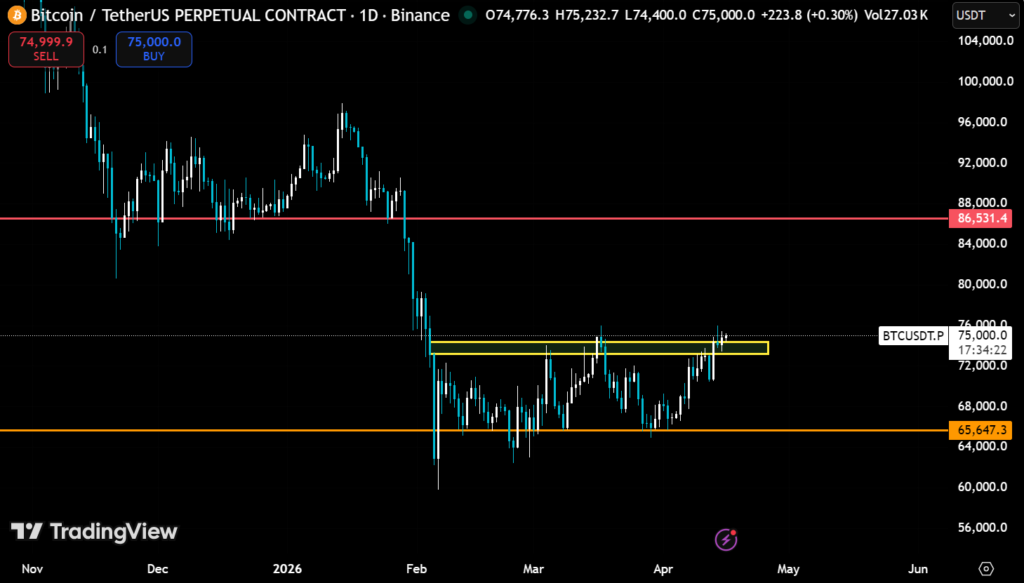
Following a sharp multi-week decline from the $86,531 zone, which now marks a prominent horizontal resistance level, Bitcoin found a floor near $62,000-$63,000 in early February and began a slow, grinding consolidation. That base has been building between approximately $72,000 and $75,000 for the better part of ten weeks, forming a visible compression box on the daily timeframe.
Thursday’s session printed an open of $74,776.3, a high of $75,232.7, a low of $74,400.0, and a close at $75,000.0 on 27.03K contracts, with the price tagging the upper bound of that compression zone on an intraday basis. The daily candle is effectively a test of the box’s ceiling, and what follows in the next two to three sessions will matter structurally.
The key levels visible on the chart are not complicated; $86,531.40 is the red overhead resistance line, representing the breakdown origin from February. $65,647.30 is the orange support line sitting below, which aligns roughly with the February flush low area. The yellow consolidation box spanning $73,000 to $74,300 is the battleground currently in play.
The Side of Momentum Indicators
The 14-period RSI at 62.55 leaves room to run before hitting overbought territory, while the 7-period at 69.41 shows the more recent sessions carrying noticeably stronger momentum than the broader sample. That spread between the two readings is worth keeping in mind. Short-term momentum is outpacing the medium-term baseline, which is normal at the early stage of a breakout attempt, but it also means any stall near resistance will register in the faster oscillator before it shows up in price.
The MACD adds to the constructive read. The line at 1,261.32 sits well above the signal at 608.43, with the histogram printing 652.89 and widening, meaning momentum is not just positive but building. The scenario worth watching is a histogram rollover while the price continues pushing higher near the $75,232 to $76,000 zone. Such divergence, where the candles gradually rise while internal momentum quietly diminishes, often serves as the earliest indication that the move is losing momentum before the price itself confirms it.
The moving average trend points out that Bitcoin currently trades above both the 7-day SMA at $73,146.55 and the 30-day SMA at $69,978.42, which sit as layers of dynamic support beneath the current price and confirm the short-term recovery is real. The problem is what sits above. The 200-day SMA at $87,347.37 and the 200-day EMA at $82,880.74 are 12.3% and 10.4% away, respectively, and the price remains firmly below both. Short-term trend and long-term trend are pointing in opposite directions, which means the recovery thesis is valid but operating within a structure that is still technically bearish at the macro level.
Fibonacci Tells the Upside Story
Measured from the swing low at $64,971.71 to the swing high at $76,061.76, the 127.2% Fibonacci extension lands at $79,078.25, roughly 5.3% above the current price. What makes this level relevant beyond the calculation itself is that there is very little structural resistance between here and there. If the consolidation box breaks with conviction, $79,078 is the first place the chart gives sellers a reason to show up.
The 161.8% extension at $82,915.41 lands within a 35-dollar range of the 200-day EMA at $82,880.74, producing a technically dense zone in the $82,880 to $83,000 area where two independent frameworks align. Fibonacci extension targets gaining this kind of confirmation from a major moving average are rarely coincidental in terms of market behavior, as they tend to concentrate sell-side interest from participants using different analytical methods. Should the current momentum carry the price through $79,078, that $82,880 to $83,000 cluster becomes the primary structural test, and the quality of price action when it arrives there will likely define whether this recovery attempt has the structural integrity to push further toward the $86,531 breakdown origin above.
On the downside, the Fibonacci retracement levels from the same swing structure define the support map clearly. The 50% retracement at $70,516.73 and the 61.8% level at $69,208.11 form a support band that aligns broadly with the 30-day SMA at $69,978.42. A pullback that holds this cluster would keep the recovery thesis structurally intact. The daily pivot at $74,587.85 is the first intraday reference to watch on any near-term weakness.
Macro Context Grounds the Outlook
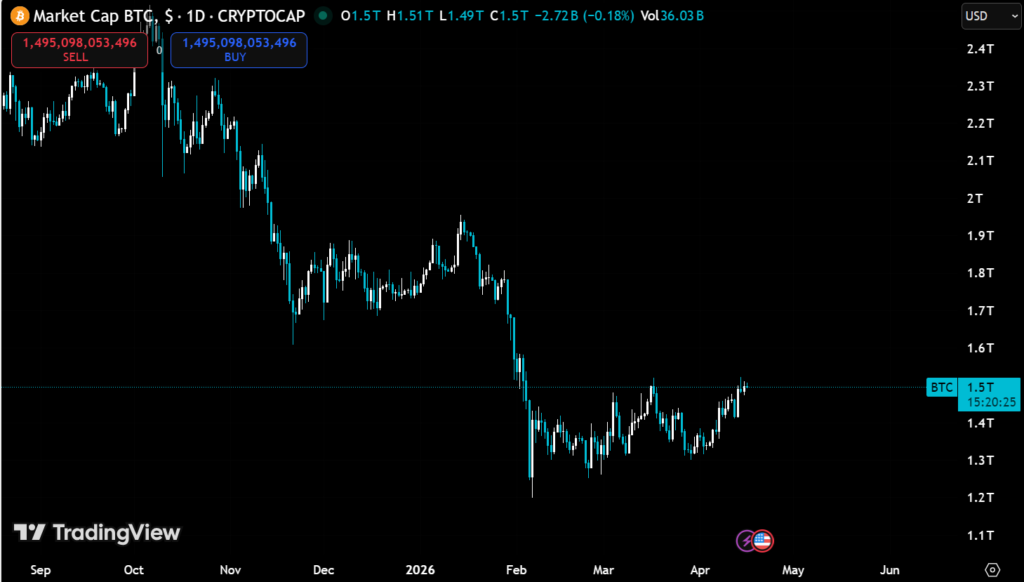
With a market cap of $1.50 trillion and 24-hour volume at $36 billion, the turnover ratio of 0.025556 reflects measured participation, not the kind of aggressive volume profile that typically accompanies a high-conviction breakout. The broader volume context, $384.47 billion over seven days and $1.23 trillion over thirty, looks reasonable, but the 24-hour volume dropping 25.04% compared to the prior session is the detail that matters most here. The push to $75,000 came on shrinking volume, and that alone is enough reason to want confirmation before treating the move as a clean structural break rather than a low-energy test of the ceiling.
The YTD change of -15.38% and a current drawdown of 40.5% from the all-time high of $126,198.07 frame show where Bitcoin sits in the larger cycle. Recovery momentum exists in the short-term data, but the asset is still operating in a corrective context from a macro perspective.
The Current Setup To Note
The immediate question is whether Bitcoin can post a daily close above $75,000 to $75,232 with a confirming volume expansion. A sustained close above the consolidation box ceiling opens the path toward the Fibonacci 127.2% extension at $79,078, and eventually the $82,880 to $86,531 zone where both the 200-day EMA and the prior breakdown resistance converge. Failure to hold above the box top, particularly on a 24 to 48-hour timeframe, would reinstate the range-bound structure and put the daily pivot at $74,587 and the lower box boundary near $72,000 back in focus as reference levels.