





Table of Contents
Pakistan has opened the way for licensed cryptocurrency firms to access regulated financial services, marking a major policy shift after years of restrictions on the sector.
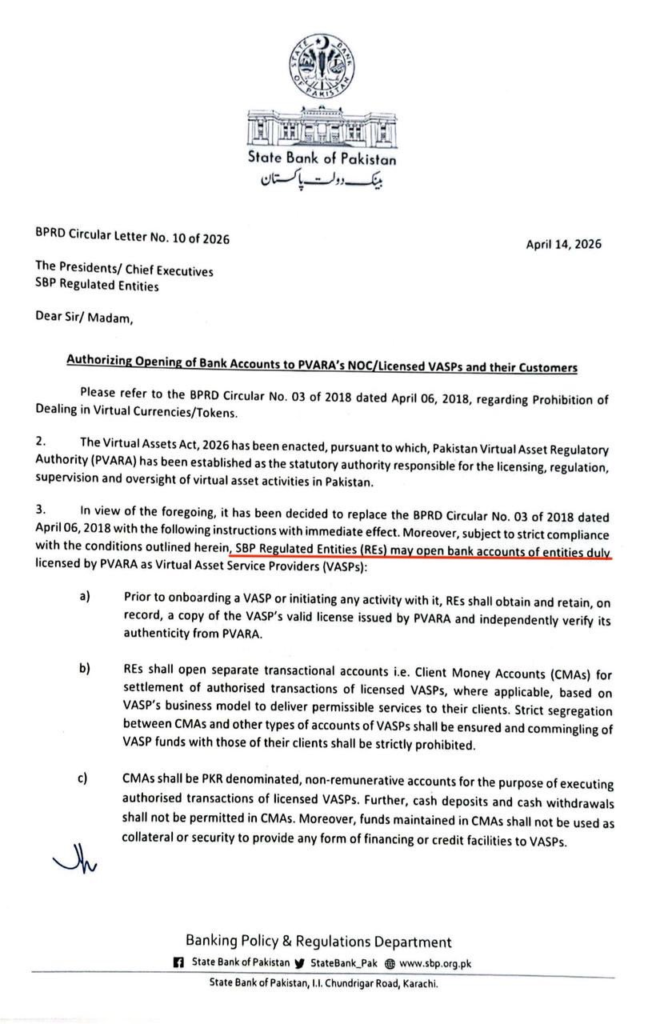
Pakistan Virtual Assets Regulatory Authority said on X that Pakistan had moved to formalize its virtual asset market after the State Bank of Pakistan issued a new circular permitting banks and other regulated entities to provide accounts to PVARA-licensed virtual asset service providers and their customers under strict AML/CFT and compliance conditions.
The State Bank’s circular, dated April 14, follows the enactment of the Virtual Assets Act, 2026, under which PVARA was established as the statutory authority responsible for licensing, regulating, and supervising virtual asset activity in the country.
Critical Shift Toward a Regulated Market
The move replaces the central bank’s 2018 order prohibiting dealings in virtual currencies and tokens, as Pakistan moves from blocking the sector to regulating it.
Under the new instructions, regulated entities must verify that any virtual asset service provider holds a valid license issued by PVARA before opening accounts or starting any business relationship. Banks are also required, where applicable, to maintain separate transactional accounts for client funds tied to authorized activity by licensed firms.
Those accounts, classified as Client Money Accounts, must be denominated in Pakistani rupees and kept separate from other accounts belonging to the service provider. The central bank said cash deposits and withdrawals would not be allowed in such accounts, while funds held there could not be used as collateral for loans or other financing.
Compliance Guardrails Remain Tight
The new framework imposes strict compliance obligations on banks and other regulated entities, requiring them, in addition to existing customer due diligence rules, to gather sufficient information to understand a service provider’s business model, customer onboarding process, customer base, and the markets in which it operates.
They must also update their risk profiling models to reflect the risks associated with virtual asset firms, put in place appropriate controls, and keep those relationships under ongoing review, while reporting suspicious transactions to the relevant authorities in line with Pakistan’s anti-money laundering framework.
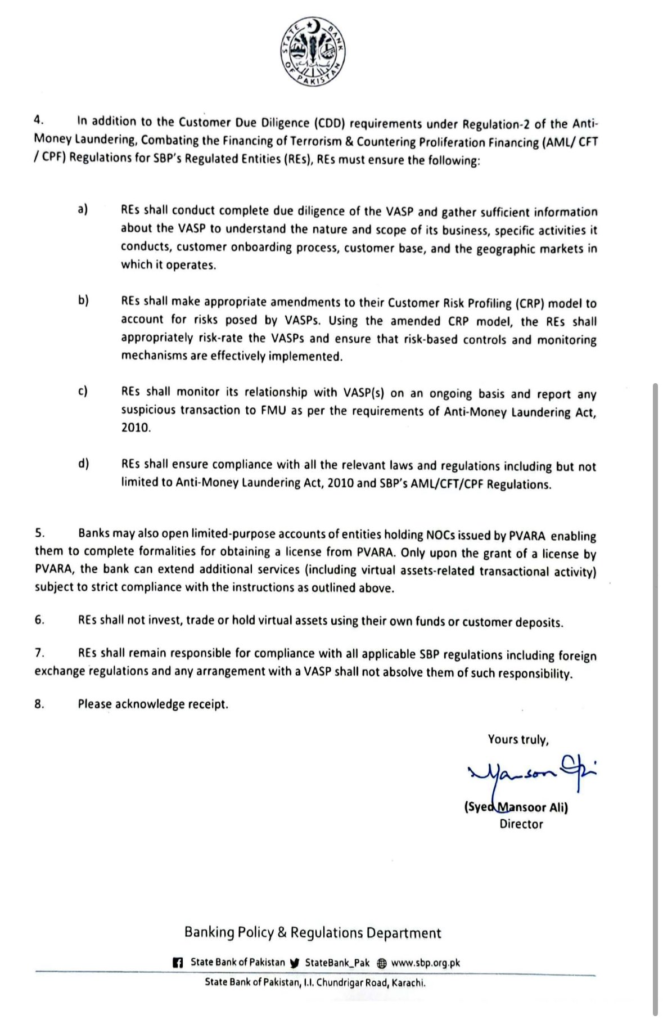
The circular further allows banks to open limited-purpose accounts for entities that hold no-objection certificates from PVARA while they complete licensing requirements. However, virtual asset-related transactional services can only be extended once a full license has been granted.
The State Bank also made clear that its regulated entities cannot invest in, trade, or hold virtual assets using either their own funds or customer deposits. Banks will remain responsible for complying with all applicable central bank rules, including foreign exchange regulations, regardless of any arrangement with a virtual asset service provider.


